How can we improve material flow efficiency in our pulp mill?
Improving material flow efficiency in a pulp mill starts with eliminating equipment bottlenecks, optimizing machine selection for your specific wood handling volumes, and investing in energy recovery technology. These three levers, applied together, consistently deliver the most measurable gains in pulp mill throughput and operating cost reduction. The sections below address the most common questions pulp mill operators ask when evaluating where to focus their improvement efforts.
What are the biggest bottlenecks in pulp mill material flow?
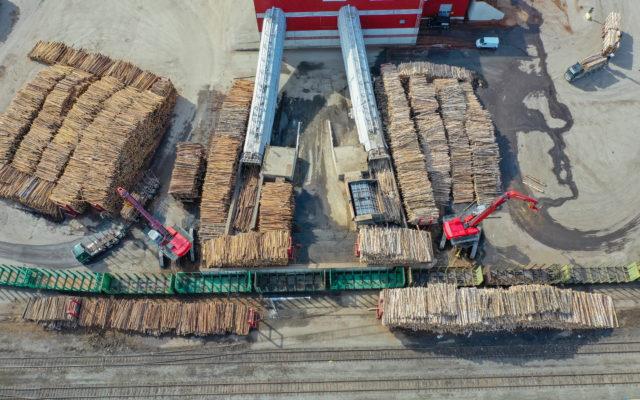
The biggest bottlenecks in pulp mill material flow are typically equipment capacity mismatches, poor yard layout, and insufficient machine availability during peak demand periods. When a single handler is responsible for multiple tasks across a large wood yard, even a brief breakdown or maintenance stop can cascade into significant production delays throughout the entire mill.
In practice, bottlenecks tend to cluster around a few recurring problem areas. Log and chip handling at the infeed point is a common pressure zone, particularly when incoming delivery volumes are uneven. If handlers cannot clear incoming loads fast enough, trucks queue, schedules slip, and the ripple effect reaches the chipping line and digester feed. Similarly, stockpile management becomes a bottleneck when machines lack the reach or lifting capacity to handle large roundwood piles efficiently.
Maintenance scheduling is another underappreciated source of flow disruption. Machines that are not serviced proactively tend to fail at the worst possible moments, often during high-volume periods. Building redundancy into your equipment fleet and aligning service windows with natural production lulls are practical steps to protect material flow continuity.
How does equipment selection affect pulp mill throughput?
Equipment selection directly determines pulp mill throughput because the lifting capacity, reach, cycle time, and reliability of your material handlers set the physical ceiling on how much wood can be processed per shift. Choosing a machine that is undersized for your yard’s volume means your handlers will always be working at their limit, leaving no buffer for demand spikes or unplanned delays.
Reach and lifting capacity are the two most critical specifications for wood handling efficiency. A machine that can work a larger radius reduces the need for repositioning, which shortens cycle times and increases the volume of material moved per operating hour. Hydraulic material handlers for pulp mill environments, rather than general-purpose cranes adapted for the task, deliver meaningfully better performance because their hydraulics, grapples, and booms are engineered for the density and variability of roundwood.
Reliability is equally important. A high-capacity machine with poor uptime contributes less to throughput than a moderately sized machine with excellent availability. When evaluating equipment, look closely at the manufacturer’s service network, spare parts availability, and mean time between failures for the specific model you are considering.
What’s the difference between diesel, electric, and hybrid material handlers for pulp mills?
Diesel material handlers offer maximum mobility and are independent of fixed power infrastructure, making them well suited for large, open wood yards where machines need to reposition frequently. Electric handlers deliver lower operating costs and zero local emissions but require a stable grid connection and fixed or semi-fixed working positions. Hybrid systems combine both power sources to capture the efficiency benefits of electric operation while retaining diesel flexibility.
Diesel handlers
Diesel-powered machines remain the most common choice in pulp mill yards where the working area is large and the machine needs to travel significant distances between tasks. They are straightforward to operate and maintain, and they are not dependent on electrical infrastructure. The trade-off is higher fuel cost and emissions compared to electrified alternatives.
Electric handlers
Electric material handlers are increasingly practical for mills that have reliable grid access and defined working zones. Operating costs are substantially lower than diesel equivalents, and the absence of exhaust emissions improves air quality in enclosed or semi-enclosed terminal areas. The upfront infrastructure investment for cabling and power supply needs to be factored into the total cost of ownership calculation.
Hybrid handlers
Our DualPower concept combines a diesel engine and an electric motor in a single machine, giving operators the flexibility to switch between power sources depending on the task and the available infrastructure. This approach is particularly valuable for mills that are transitioning toward electrification but cannot yet commit to fully electric operations across the entire yard. The result is a machine that reduces fuel consumption and emissions without sacrificing the mobility that pulp mill operations demand.
How can energy recovery systems reduce pulp mill operating costs?
Energy recovery systems reduce pulp mill operating costs by capturing the kinetic energy generated when a material handler’s boom lowers under load and feeding that energy back into the machine’s power system. In high-cycle applications like wood handling, this recovered energy can reduce total energy consumption significantly, lowering both fuel costs and electrical draw over thousands of operating hours.
Our Hybrilift® system was developed specifically to address this opportunity. Hybrilift captures the energy from the boom’s downward movement and makes it available for the next lift cycle — energy that would otherwise be lost as heat. In continuous wood handling operations, this cycle repeats hundreds of times per shift, and the cumulative energy savings are substantial. Mills that have adopted this technology report meaningful reductions in operating costs over the lifetime of the machine.
Beyond direct energy savings, recovery systems reduce thermal load on the hydraulic circuit, which can extend component life and reduce cooling system demands. This secondary benefit is easy to overlook in a straight energy cost calculation but adds real value over a multi-year ownership period.
When should a pulp mill operator consider upgrading material handling equipment?
A pulp mill operator should consider upgrading material handling equipment when machines are consistently limiting throughput, when maintenance costs are rising faster than production output, or when energy costs have become a significant line item that newer technology could reduce. Age alone is not the primary trigger; performance and cost trajectory are.
Specific signals that an upgrade conversation is warranted include:
- Unplanned downtime is increasing and disrupting production schedules
- Spare parts for existing machines are becoming difficult to source
- Fuel or energy costs per tonne of wood handled are rising year over year
- The yard’s throughput requirements have grown beyond what the current fleet can sustain
- Newer equipment would qualify for available sustainability incentives or carbon reduction programs
A useful exercise is to calculate the total cost of ownership for your current machines against a modern equivalent, factoring in energy recovery, reduced maintenance, and higher availability. In many cases, the payback period on a new hydraulic material handler is shorter than operators initially expect.
What role does operator experience play in material flow efficiency?
Operator experience plays a significant role in material flow efficiency because skilled operators make faster, more precise decisions about load sequencing, grapple positioning, and machine movement that collectively add up to meaningfully higher throughput per shift. The gap between an experienced operator and an inexperienced one on the same machine can represent a substantial difference in daily wood handling volume.
Experienced operators also tend to handle equipment more smoothly, which reduces mechanical stress on booms, hydraulics, and grapples. This translates directly into lower maintenance frequency and longer component life. Training programs that build operator skill systematically, rather than relying purely on on-the-job learning, accelerate the time it takes new operators to reach peak efficiency.
We bring a perspective to this that most equipment manufacturers cannot: we operate our own machines in real pulp mill and steel industry environments as a service provider. That direct operational experience, accumulated over more than 60 years and across hundreds of millions of cubic meters of wood, informs how we design our machines and the practical guidance we offer to customers. Learn more about our company history and operational expertise and how it consistently produces better material flow outcomes than machines that are technically capable but difficult to use well.