Who is a good alternative to Liebherr or Sennebogen?
Choosing the right material handler for port and terminal operations is one of the most significant capital decisions a logistics operator can make. With Liebherr and Sennebogen long established as leading names in the industry, it is natural to ask whether other manufacturers offer comparable or superior solutions. The answer is yes, and understanding what to look for makes the comparison straightforward.
This article walks through the key questions port operators, terminal managers, and bulk-handling professionals ask when evaluating a Liebherr alternative or Sennebogen alternative for their operations. Whether you handle wood chips, grain, scrap metal, or general cargo, the right hydraulic material handler can transform your throughput, reduce energy costs, and strengthen your position in a competitive logistics chain.
Why do port operators look for alternatives to Liebherr and Sennebogen?
Port operators look for alternatives primarily to find better alignment between machine capability, energy efficiency, total cost of ownership, and long-term support. As port operations face increasing competitive pressure and tightening environmental regulations, operators need partners who bring both innovation and deep operational experience to the table.
The material-handling market has matured significantly, and several manufacturers now offer machines that match or exceed established brands in specific performance categories. Operators increasingly seek suppliers who understand the full logistics flow, not just the machine itself. Factors driving procurement teams to broaden their evaluation include:
- Energy-recovery systems that reduce fuel consumption and emissions
- Operator comfort and ergonomics
- Customizable attachments for different cargo types
- The ability to scale across operations of different sizes
There is also a growing demand for manufacturers that operate their own machines in real-world conditions. This operational experience translates directly into better machine design, more practical support, and solutions genuinely optimized for the challenges operators face every day — rather than engineered purely in theory.
What should you look for in a material handler for port operations?
When selecting a port material handler, the most important factors are lifting capacity, reach, work cycle speed, energy efficiency, attachment versatility, and the availability of reliable local support. A machine that excels in only one of these areas will create bottlenecks elsewhere in your operation.
Capacity and reach
Port operations require machines that can serve vessels ranging from small coastal freighters to Panamax-class bulk carriers. The machine’s reach and lifting capacity must match your typical vessel profile and quay layout. A handler that cannot reach the far side of a hold, or lacks the capacity to carry a full grab load, will slow your entire unloading cycle.
Energy efficiency and environmental compliance
Environmental regulations at ports are tightening across Europe and globally. A material handler equipped with an energy-recovery system that captures energy during boom movements can reduce fuel consumption and emissions substantially, helping you meet compliance targets without sacrificing productivity. This is no longer a premium feature — it is an operational necessity for forward-looking terminals.
Attachment flexibility
Ports rarely handle a single material type. Your material handler should support a wide range of attachments, including:
- Clamshell buckets for bulk cargo
- Scrap grabs
- Spreaders for containers
- Specialized tools for steel products
Quick-coupler systems that allow fast and safe attachment changes are essential for maximizing machine utilization across shift changes and cargo types.
Operator experience and safety
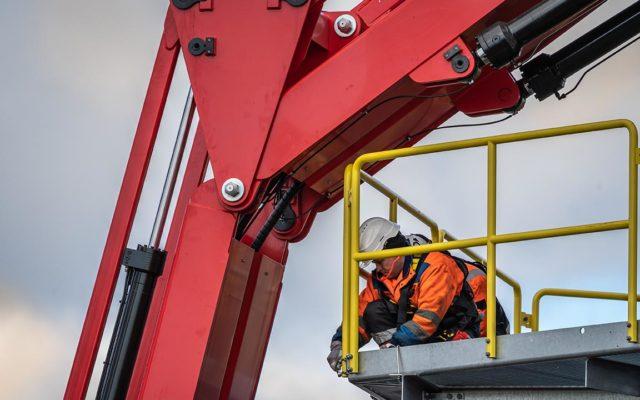
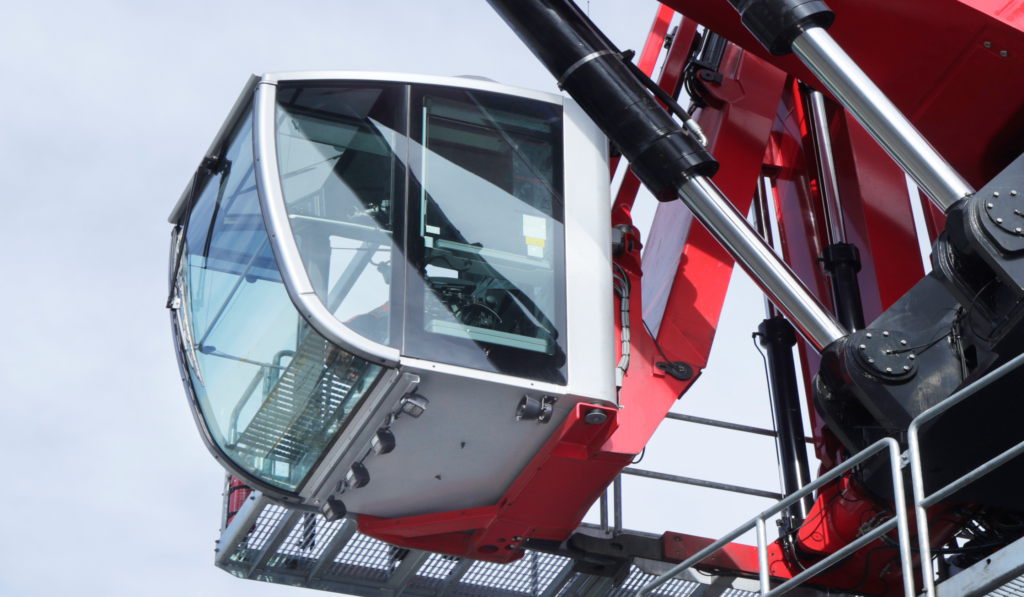
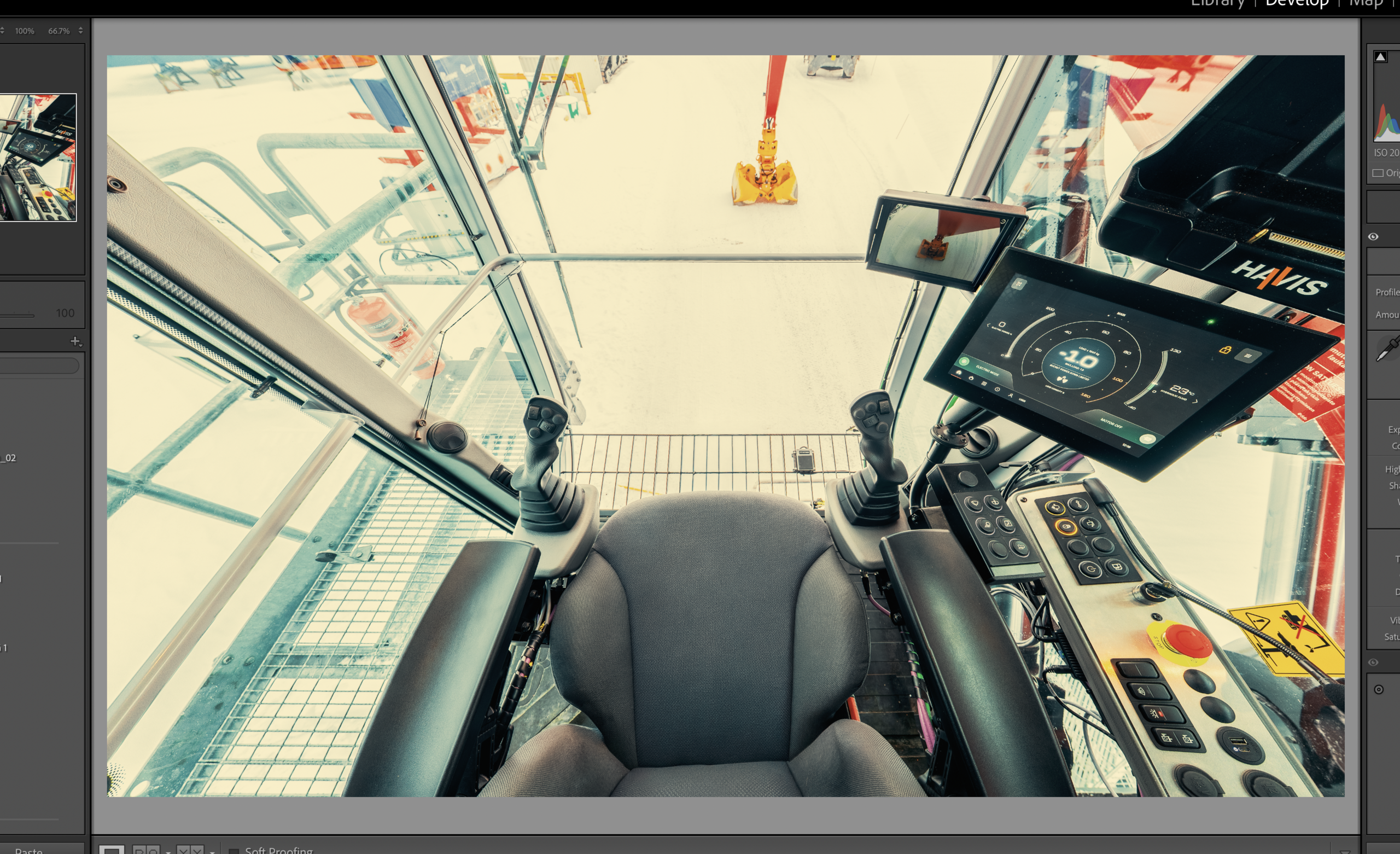
Operator fatigue and error are real factors in productivity and safety. Machines with spacious, ergonomically designed cabins, good sightlines, and intelligent load-control systems reduce incidents and improve cycle times. Safety systems should be standard, not optional extras.
How does Mantsinen compare to Liebherr and Sennebogen?
We offer a compelling alternative to both Liebherr and Sennebogen by combining Finnish engineering precision with more than 60 years of hands-on operational experience at woodyards, ports, and terminals worldwide. Our machines are sold in more than 50 countries and are recognized for their robustness, energy efficiency, and fast work cycles.
One distinction that sets us apart is that we do not only build machines — we also operate a fleet of them at woodyards and industrial sites. This makes us the only manufacturer in the material-handling industry with this level of first-hand operational knowledge. Our machines are designed based on real-world feedback from daily operations, not just engineering specifications.
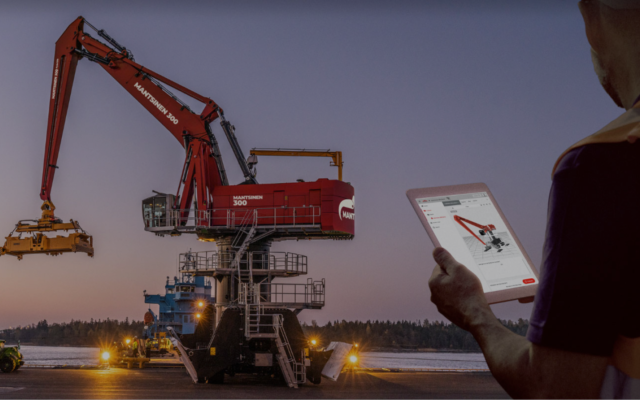
Our product range spans from the compact Mantsinen 60 and 70, suited to versatile terminal and mill operations, all the way to the Mantsinen 300, the world’s largest hydraulic material handler. This range means we can match the right machine to your specific port scale, cargo type, and throughput requirements — rather than asking you to adapt your operation to a limited product line.
We also offer a genuine long-term partnership model. We help you with layout planning, dimensioning, and logistics-flow optimization, and we provide readily available local support services for your operations to minimize downtime and maximize predictability across your operation.
What is the Mantsinen Hybrilift® system, and how does it save energy?
The Mantsinen Hybrilift® is an energy-recovery system that captures kinetic energy generated when the boom lowers and reuses it to assist in lifting. Compared with conventional hydraulic material handlers, it can reduce energy consumption and operating costs by up to 50%.
We began developing the Hybrilift® system in 2006, making us one of the earliest pioneers of energy-recovery technology in the material-handling sector. When a loaded boom lowers, the system captures the kinetic and potential energy that would otherwise be lost as heat and stores it for reuse in subsequent lifting cycles. This regenerative approach significantly reduces the load on the primary power source.
For port operators, this translates into lower fuel bills, reduced emissions, and extended service intervals. The Hybrilift® system is available across several models in our range, including the Mantsinen 200 and the flagship Mantsinen 300, for which a next-generation version has been developed and patented specifically for the demands of large-scale port operations.
A Hybrilift®-equipped Mantsinen machine helps terminals demonstrate measurable progress toward sustainability targets — increasingly important for port authorities and cargo owners evaluating their supply-chain partners.
Which material handler is best for handling bulk cargo at scale?
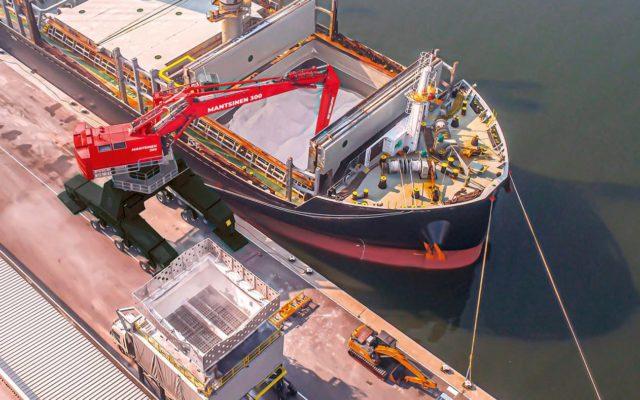
For large-scale bulk cargo handling, the Mantsinen 300 is the most productive option available, offering the fastest work cycle in its size class and the ability to serve vessels up to Panamax class. For mid-size ports, the Mantsinen 160 and 200 deliver exceptional reach, speed, and capacity for high-frequency bulk operations.
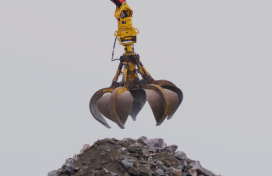
Bulk materials such as wood chips, grain, fertilizers, iron ore, sand, and gravel each have distinct handling characteristics. The right machine needs to be paired with the right attachment. Our clamshell buckets are engineered for specific material densities and flow properties, ensuring maximum fill rates and minimal spillage. The shape of each bucket and the cylinder force are matched to the material being handled, which directly improves throughput efficiency.
The Mantsinen 200 is particularly well suited to medium-size port operations. It handles bulk materials, general cargo, and fully loaded containers up to five rows wide and four high — giving terminal operators genuine versatility without needing multiple machines for different cargo types. Combined with the Hybrilift® system and an elevated, spacious operator cabin, the 200 delivers productivity and comfort in equal measure.
For smaller terminals or operations that require agility alongside strength, the Mantsinen 120 and 140 are proven workhorses across ship-loading and unloading applications, as well as pulp and steel mill raw-material feeding. The Mantsinen 120, in particular, has one of the largest reference lists in our portfolio, demonstrating its reliability across a wide range of customer environments.
How do you evaluate the total cost of ownership for a material handler?
Total cost of ownership includes the purchase price, energy costs, maintenance and downtime expenses, operator productivity, attachment costs, and end-of-life residual value. Evaluating only the initial price is one of the most common — and costly — mistakes port operators make when comparing machines.
Energy and fuel costs over the machine’s lifetime
A machine that costs more upfront but consumes significantly less energy can deliver lower total costs over a ten- or fifteen-year operational period. Energy-recovery systems like our Hybrilift® — which can reduce energy use by up to 50% — represent meaningful savings at scale, particularly for machines running multiple shifts per day.
Downtime and maintenance
Unplanned downtime at a port has cascading effects on vessel schedules, demurrage costs, and customer relationships. Machines built to the highest design classifications, with robust components and intelligent monitoring systems, reduce the frequency and cost of maintenance interventions. We design our machines for maximum uptime and offer readily available local support to minimize disruption when service is needed.
Productivity per ton handled
The cost per ton of material handled is one of the most useful benchmarks for comparing machines. A faster work cycle, a higher fill rate per grab, and reduced idle time all contribute to a lower cost per ton. Our tailored solutions are specifically designed to minimize the total cost per ton handled while keeping emissions low and operational predictability high.
When you evaluate a harbour crane alternative or a new bulk material handling machine, look beyond the brochure specifications and consider the full picture: energy-recovery capability, attachment range, operator ergonomics, manufacturer experience, and the quality of the long-term support relationship. Contact our sales team for expert advice on finding the right machine for your operation. That is where the real difference between machines becomes clear.