Can one machine handle both small and large vessels efficiently?
Yes, one machine can handle both small and large vessels efficiently, provided it is specified with the right reach, lift capacity, and control flexibility. Modern hydraulic material handlers are engineered to work across a wide range of vessel types, from coastal barges to large ocean-going bulk carriers, without requiring operators to switch equipment between jobs. The sections below unpack exactly how that adaptability works in practice.
What makes vessel size variation a challenge for port operators?
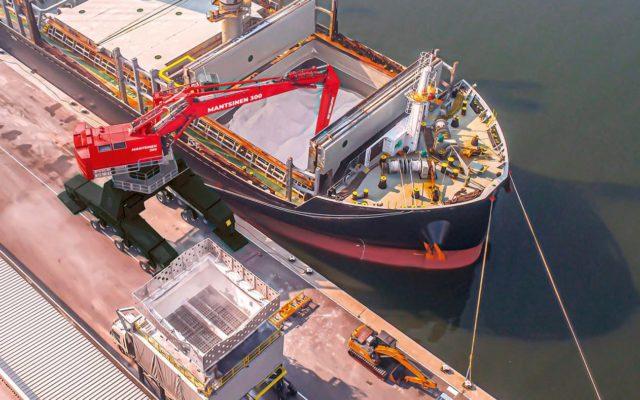
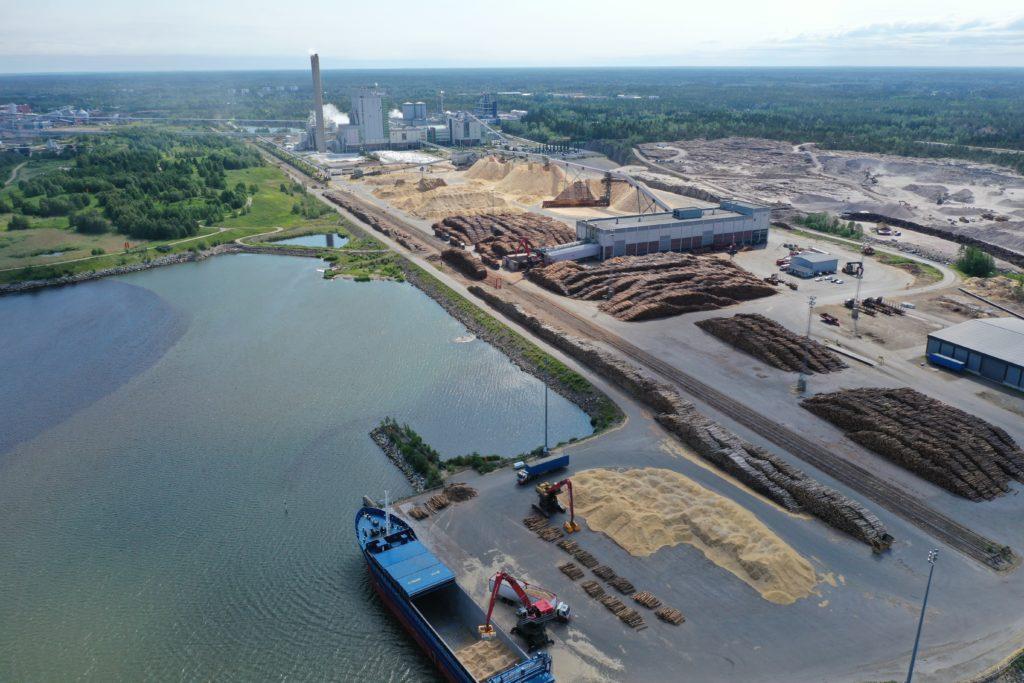
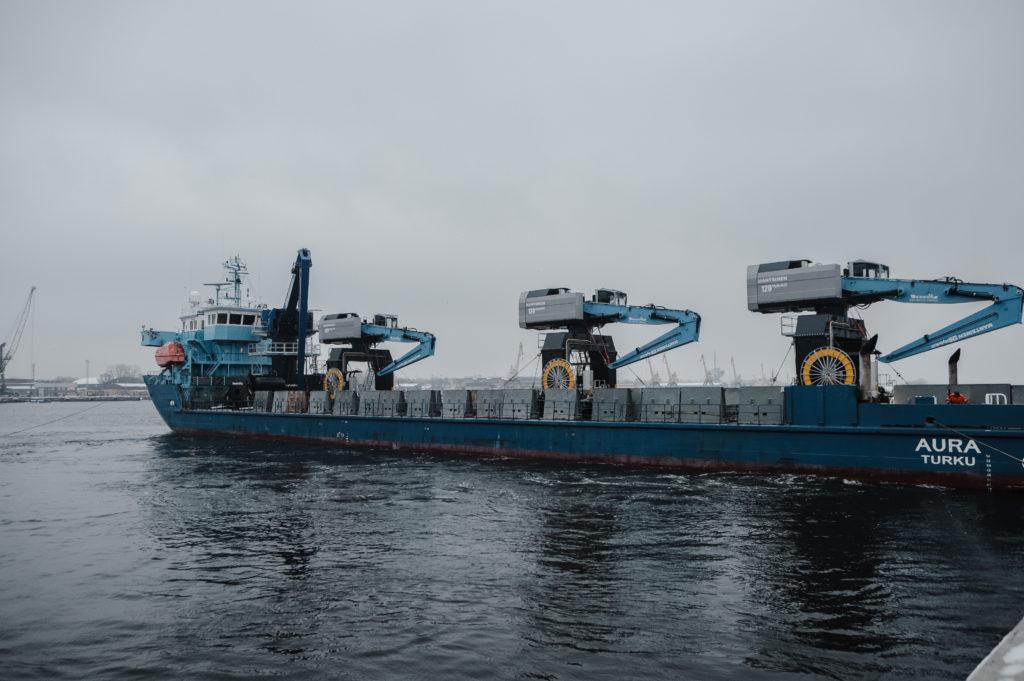
Vessel size variation creates a challenge because different ships demand fundamentally different operating parameters. A small coastal barge may sit low and close to the quay, while a large bulk carrier rides high and far from the dock face, requiring greater reach and lift height. A single terminal that receives both vessel types must either match equipment to each job or find one machine capable of bridging that gap without compromising throughput.
The practical consequences of a mismatch are significant. When a machine lacks the reach to work the far hatch of a large vessel, productivity drops because cargo must be repositioned manually or with auxiliary equipment. When a heavy-lift machine is used on a small barge, the cost per tonne rises sharply because the machine is oversized for the task and consumes more fuel than necessary. Port logistics planners also face scheduling pressure: if a terminal relies on separate machines for different vessel classes, both assets must be available simultaneously, which increases capital expenditure and maintenance complexity.
Bulk material handling adds another layer of difficulty. Materials such as wood chips, coal, scrap metal, and grain behave differently under a grab, and the optimal grab size depends on the hatch dimensions of the vessel being worked. Smaller hatches on coastal vessels restrict grab width, while larger holds on ocean-going ships reward bigger grabs and higher cycle speeds. A terminal that handles mixed vessel sizes must therefore consider equipment flexibility from the outset rather than treating each vessel class as a separate procurement problem.
How does a single material handler adapt to different vessel sizes?
A single hydraulic material handler adapts to different vessel sizes through a combination of variable boom geometry, interchangeable work tools, and programmable control systems. The operator adjusts reach and working radius to match the vessel’s freeboard and hatch position, while the attachment, typically a hydraulic grab, is swapped to suit the cargo type and hatch dimensions of the specific ship alongside.
Boom configuration is the primary mechanical lever. Modern material handlers for ports and terminals cargo handling are built with multi-section boom and stick arrangements that allow the operator to position the attachment precisely over hatches at varying distances from the quay edge. This geometry means the same machine can reach into the hold of a large bulk carrier berthed at the far side of a wide quay and then work a small barge moored closer in, simply by adjusting the stick angle and slew position.
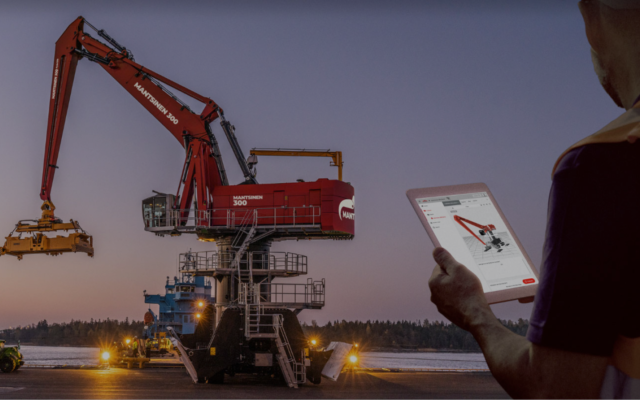
Control software plays an equally important role. Advanced machines use load management systems that automatically adjust hydraulic pressure and flow to match the weight of the current grab and its contents. This prevents overloading on heavy-lift tasks while maintaining fast cycle times on lighter materials. Some machines also offer operator-selectable working modes that tune the hydraulic response for precision work in confined hatches versus high-speed bulk throughput in open holds.
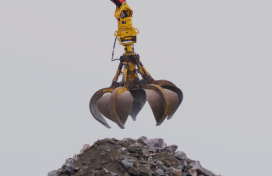
Interchangeable attachments complete the picture. A terminal handling both grain and scrap metal, for example, can fit a closed clamshell grab for the former and an orange-peel grab for the latter. Because the hydraulic quick-coupler system allows fast attachment changes, one machine can move between vessel types and cargo categories within the same shift.
What capacity and reach specifications actually matter for mixed-vessel operations?
For mixed-vessel operations, the specifications that matter most are maximum lift capacity at full outreach, working radius at the quay face, maximum outreach over the vessel side, and hoist height above the quay level. These four figures together define whether a machine can physically reach every hatch on the largest vessel it will encounter while still operating efficiently on the smallest.
- Lift capacity at full outreach: Capacity at the tip of the boom, not at the machine’s centre, is the figure that determines whether the machine can lift a fully loaded grab from the deepest hold of a large vessel. A machine rated at high capacity close to the slew centre but with sharply reduced capacity at full reach may struggle with large grabs on wide-beam ships.
- Working radius: This defines how far from the quay edge the machine can place its attachment. For large bulk carriers with wide beams, a working radius of at least 20 metres is typically required to reach the far hatches without repositioning the machine along the quay.
- Maximum outreach over the vessel side: Related to but distinct from working radius, this figure accounts for the height of the vessel’s freeboard and the angle of the boom. A high-freeboard vessel requires greater vertical reach before the boom can extend outward over the hold.
- Hoist height: The maximum height to which the attachment can be lifted above quay level determines whether the machine can clear the vessel’s rail and coaming without fouling. Insufficient hoist height forces operators to use smaller grabs, reducing cycle productivity.
For terminals that regularly receive both small coastal vessels and large ocean-going bulk carriers, specifying a machine at the upper end of the reach and capacity envelope for the largest vessel expected is the safest approach. A machine with excess capacity for smaller vessels costs more upfront but avoids the far greater cost of productivity loss when a large vessel arrives and the equipment cannot reach its hatches.
Does handling both vessel sizes affect fuel costs and energy efficiency?
Yes, handling a mix of vessel sizes can affect fuel costs and energy efficiency, but modern material handlers are designed to minimise that impact by recovering and reusing energy generated during the working cycle regardless of vessel type. The key variable is whether the machine’s power system matches its output to the actual load rather than running at a fixed power level across all tasks.
Conventional diesel-powered machines consume fuel at a rate broadly proportional to the hydraulic demand placed on them. When a large machine works a small barge with a light grab, it still runs its engine at a level sufficient to maintain hydraulic pressure, which means fuel consumption does not drop as sharply as the workload does. Over a shift that mixes small and large vessel work, this inefficiency accumulates.
Energy recovery systems address this directly. Our Mantsinen Hybrilift® system, for example, captures the energy generated when the boom lowers and stores it for reuse on the next lift cycle. This recovery mechanism is effective regardless of vessel size because the energy generated during descent is proportional to the weight being lowered, not the size of the ship being worked. Terminals that have adopted material handlers equipped with the Hybrilift® system report energy savings of up to 50% compared to conventional diesel-only machines, which makes the efficiency case compelling in mixed-vessel environments.
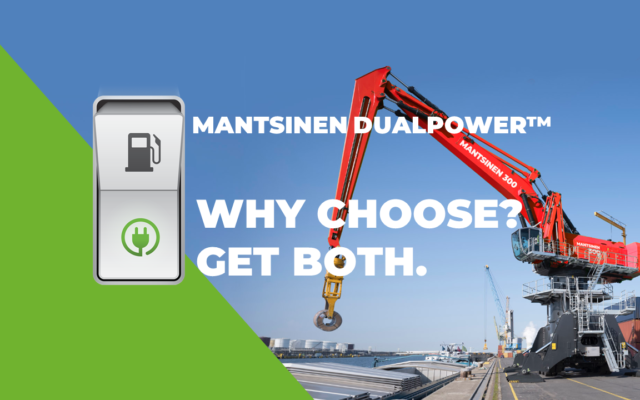
Our DualPower concept, which combines an electric motor with a diesel engine, adds further flexibility. When a terminal’s power grid can supply electricity, the machine runs on electric power with near-zero local emissions and lower operating costs. When working in areas without grid access, the diesel engine takes over. For terminals that handle both small and large vessels across different berths with varying grid access, this dual-power approach provides operational continuity without sacrificing efficiency.
When should a terminal invest in one versatile machine versus multiple specialised units?
A terminal should invest in one versatile machine when its vessel mix is unpredictable, its quay space is limited, or its throughput volume does not justify the capital and maintenance cost of two dedicated units. Multiple specialised machines make more sense when a terminal handles very high volumes of a single vessel class continuously and can guarantee full utilisation of each dedicated asset.
The investment decision comes down to three practical factors:
- Utilisation rate: A single versatile machine that runs at high utilisation across a mixed vessel schedule generates a better return on capital than two specialised machines that each sit idle for part of the day. If the terminal cannot guarantee that a large-vessel machine and a small-vessel machine will both be productively occupied, the single-machine approach is financially stronger.
- Quay and yard space: Every machine requires a travel path along the quay and a maintenance bay. Smaller terminals with constrained infrastructure often find that one large, capable machine is easier to accommodate than two units competing for the same quay space.
- Operational flexibility: A single versatile machine simplifies crew scheduling, maintenance planning, and spare parts inventory. Operators trained on one machine type are interchangeable across all vessel work, whereas a two-machine fleet may require separate operator certifications and maintenance skill sets.
The argument for multiple specialised units strengthens as volume grows. A large bulk terminal handling several million tonnes per year of a single commodity, with a predictable mix of vessel sizes arriving on a fixed schedule, can justify dedicated equipment for each vessel class because the utilisation of each machine remains high. In that scenario, optimising each machine for its specific task delivers measurable gains in cycle time and fuel efficiency that a versatile machine cannot fully replicate.
For most mid-sized terminals and those with variable cargo streams, however, the versatile hydraulic material handler remains the stronger choice. The ability to adapt to whatever vessel arrives next, without waiting for a different machine to become available, is a competitive advantage in port logistics that compounds over time as trade patterns shift and vessel sizes fluctuate. Learn more about our material handler maintenance and support services to understand how we help terminals sustain that advantage.