Why is preventive maintenance important for harbor material handlers?
Preventive maintenance is important for harbor material handlers because it keeps machines running reliably, reduces the risk of costly unplanned breakdowns, and extends the overall service life of port equipment. Without a structured maintenance schedule, hydraulic material handling machines face accelerated wear, unexpected failures, and significant operational disruptions. The questions below unpack exactly what that means in practice for port operators and equipment owners.
What happens to a harbor material handler without preventive maintenance?
Without preventive maintenance, a harbor material handler will experience accelerated mechanical wear, increasing breakdown frequency, and ultimately premature failure of critical systems. Hydraulic material handling machines operate under intense load cycles in demanding port environments, and neglected components deteriorate far faster than those on a regular service schedule.
The consequences are not just mechanical. When a machine goes down unexpectedly in a port or terminal, the entire material flow can grind to a halt. Cargo handling delays create ripple effects across logistics chains, affecting vessel turnaround times, storage capacity, and contractual commitments. A single unplanned failure event can cost many times more than an entire year of scheduled maintenance, when you factor in emergency repairs, lost productivity, and expedited parts shipping.
Beyond cost, there are safety implications. Hydraulic systems operating at high pressure, combined with heavy lifting loads, create real hazards when seals, hoses, or structural components are allowed to degrade undetected. Preventive maintenance is not just about machine uptime. It is a foundational part of operating port equipment safely and responsibly.
How often should harbor material handlers be serviced?
Harbor material handlers should follow a structured, periodic maintenance schedule defined by the manufacturer, typically based on operating hours rather than calendar time. Service intervals vary by component, with some checks required every few hundred hours and major inspections occurring at longer intervals. High-intensity port operations may require more frequent attention than lighter-duty applications.
Our recommendation is that periodic maintenance on Mantsinen hydraulic material handlers is carried out through our comprehensive dealer network, whose technicians are trained specifically on our machines. Following manufacturer-defined intervals ensures that nothing is overlooked and that service is performed to the correct specification every time.
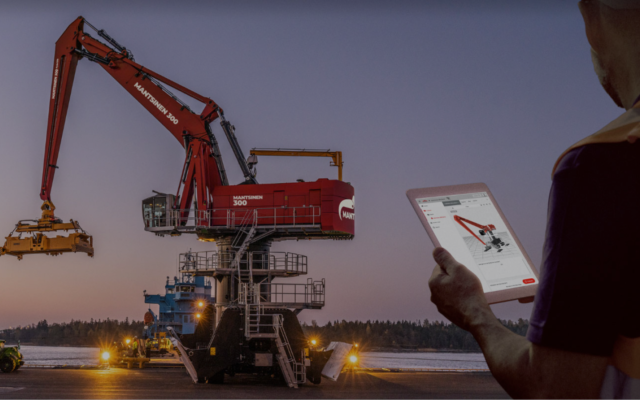
One practical tool that removes the guesswork from scheduling is the Mantsinen Insight telematics system. It can be configured to automatically notify the machine operator or owner when a service interval is approaching, based on actual operating hours logged by the machine. This means maintenance is triggered by real-world usage data rather than rough estimates, keeping the machine on the correct schedule regardless of how intensively it has been working.
What are the most critical components to inspect on a harbor material handler?
The most critical components to inspect on a harbor material handler are the hydraulic system, the boom and attachment structure, the slewing ring, the undercarriage, and the engine and drivetrain. These systems carry the highest loads, operate under the most stress, and have the greatest consequences if they fail during operation.
- Hydraulic system: Hoses, seals, cylinders, and filters must be checked for leaks, pressure integrity, and contamination. Hydraulic fluid condition directly affects the performance and longevity of every actuated function on the machine.
- Boom and attachment structure: Structural welds and pin connections should be inspected for cracks or wear, particularly at high-stress joints where fatigue can develop over time.
- Slewing ring: This large bearing carries the entire rotating upper structure. Wear or damage here affects machine stability and precision, and replacement is a major undertaking if neglected too long.
- Undercarriage and travel system: Tracks, wheels, and drive components take continuous punishment in port and terminal environments and need regular lubrication and wear assessment.
- Engine and drivetrain: Oil levels, filters, cooling systems, and fuel systems require routine checks to maintain power output and prevent thermal or mechanical failures.
Electrical systems and safety devices, including load monitoring systems and emergency stops, should also be verified at each service visit. A thorough inspection touches every system, not just the most visible ones.
How does preventive maintenance affect the total cost of owning port equipment?
Preventive maintenance significantly reduces the total cost of owning port equipment by lowering repair costs, extending machine service life, and protecting residual value. The upfront cost of scheduled servicing is consistently lower than the combined expense of emergency repairs, unplanned downtime, and accelerated component replacement that results from neglect.
Port equipment operates in some of the most demanding conditions of any industrial environment. Salt air, heavy loads, continuous operation, and tight turnaround schedules all accelerate wear. Machines that receive consistent, scheduled maintenance retain their performance characteristics longer and require fewer major overhauls over their working lives.
There is also a productivity dimension to consider. A machine with high harbor equipment reliability keeps cargo moving on schedule. Lost operating hours in a port environment translate directly to lost revenue, and in some cases, contractual penalties. Preventive maintenance is therefore not simply a cost of ownership. It is an investment in sustained operational output and commercial dependability.
What’s the difference between preventive and predictive maintenance for material handlers?
Preventive maintenance follows a fixed schedule based on time or operating hours, replacing or inspecting components before failure occurs. Predictive maintenance uses real-time data and condition monitoring to identify when a specific component is actually approaching failure, allowing intervention at the optimal moment rather than at a predetermined interval.
Both approaches share the same goal: avoiding unplanned breakdowns. But they differ in how they get there.
Preventive maintenance
Preventive maintenance is structured and calendar-driven. Service tasks are performed at defined intervals regardless of whether a component shows visible signs of wear. This approach is straightforward to plan, easy to budget for, and ensures that nothing is overlooked simply because it has not yet caused a problem. For harbor material handlers, it forms the backbone of any responsible maintenance program.
Predictive maintenance
Predictive maintenance relies on condition data, such as temperature readings, vibration analysis, hydraulic pressure trends, and operating hour patterns, to anticipate failures before they happen. Telematics systems like Mantsinen Insight support this approach by providing continuous machine data that can reveal developing issues early. When the factory technical customer service team can connect remotely to a machine, they can often identify a potential problem and guide local service teams to address it before it becomes a breakdown.
In practice, the most effective maintenance strategies for port equipment combine both approaches: scheduled preventive service as the foundation, with predictive monitoring layered on top to catch what the calendar cannot anticipate.
Who is responsible for preventive maintenance on harbor material handlers?
Responsibility for preventive maintenance on harbor material handlers is shared between the equipment owner or operator, the manufacturer’s authorized dealer network, and the manufacturer’s technical support team. Each plays a distinct role in keeping the machine in peak condition.
The operator or owner is responsible for following the manufacturer’s recommended service schedule, reporting unusual behavior or performance changes promptly, and ensuring that machines are made available for scheduled service rather than deferred indefinitely due to operational pressure.
Authorized dealers and service partners carry out the actual maintenance work. We strongly recommend that periodic maintenance on our machines is performed by technicians within our dealer network, who have the specific training, tooling, and parts access to service Mantsinen equipment correctly. When maintenance is carried out by a qualified partner, the operational reliability and predictability of the machine improves significantly, because service is done to the right standard every time.
Our factory technical customer service team provides an additional layer of support. Through the Mantsinen Insight telematics connection, they can troubleshoot issues remotely, provide real-time guidance to local service teams, and help resolve problems faster than would be possible without that direct connection to the machine. This collaborative model means that no matter where a machine is operating in the world, expert support is never far away.