What type of machine is best for handling round wood, bulk, scrap in ports?
Port and terminal operations demand equipment that can handle an enormous variety of materials quickly, safely, and with minimal downtime. Whether you are loading roundwood onto a vessel, scooping bulk cargo from a ship’s hold, or moving heavy scrap metal across a yard, the machine you choose will directly determine how competitive your operation is. This guide answers the most common questions port operators ask when selecting a material handler for port use, from understanding the technology to choosing the right model for each application.
We have spent over 60 years designing, manufacturing, and operating hydraulic material handlers in ports, terminals, and industrial yards worldwide. That hands-on experience means we understand these questions not just from an engineering perspective, but from the operational reality of running machines every single day.
What types of materials are most challenging to handle in ports?
The most challenging materials to handle in ports are roundwood logs, loose bulk materials such as wood chips, grain, and iron ore, and heavy scrap metal. Each of these materials presents a unique combination of weight, shape, density, and flow characteristics that standard equipment struggles to manage efficiently at high volumes without the right attachments and machine design.
Roundwood is unpredictable by nature. Logs vary in length, diameter, and weight, and they shift during handling, which places high demands on the precision and responsiveness of the machine. Bulk materials such as fertilizers, pellets, and grain require sealed, properly sized clamshell buckets that can penetrate the material cleanly and retain it without spillage. Scrap metal, meanwhile, is one of the most punishing materials any machine will face. It is irregular, heavy, abrasive, and often contains sharp edges that stress both the grab and the machine structure.
Container handling adds another layer of complexity, requiring spreaders that align precisely with corner castings and hold loads securely at height. Steel products such as coils, plates, and beams demand attachments specifically designed to prevent surface damage during lifts. The common thread across all these materials is that a single general-purpose machine, without the right attachment and configuration, will always underperform compared to a purpose-matched solution.
What is a hydraulic material handler, and how does it work in a port?
A hydraulic material handler is a purpose-built machine that uses a hydraulic system to power a boom, arm, and attachment, enabling precise, high-speed loading and unloading of cargo in ports and terminals. Unlike traditional cable cranes, hydraulic material handlers offer direct, responsive control over both the reach and the grip of the tool, making them significantly faster and more versatile in port environments.
The core of the machine is its hydraulic circuit, which converts engine power into pressurized fluid that drives cylinders and motors throughout the boom structure. This gives the operator fine control over every movement, from the slew of the upper structure to the closing force of a grab. In a port context, this translates to faster work cycles, better positioning accuracy over a ship’s hold, and the ability to switch between material types simply by changing the attachment.
How does a hydraulic harbour crane compare to a cable crane?
A hydraulic harbour crane can more than double handling capacity compared to a traditional cable crane in many applications. The key reason is cycle time: hydraulic machines move faster through each phase of the loading or unloading cycle, and their direct control system allows operators to work closer to the limits of the machine without the risk of load swing that cable systems introduce. The result is more tons moved per hour, per shift, and per year.
Which machine is best for handling roundwood in a port terminal?
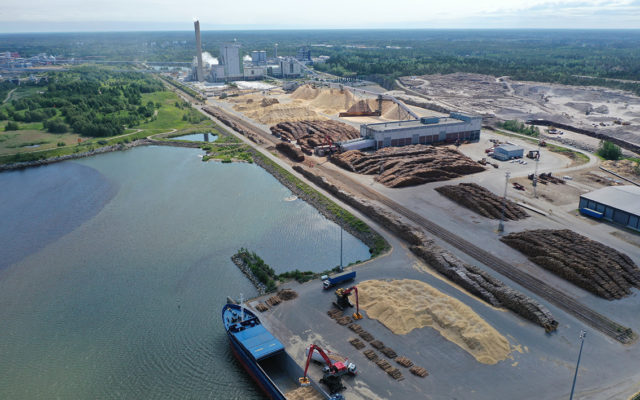
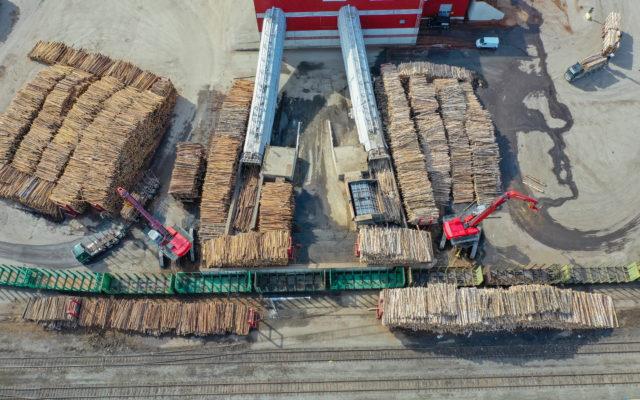
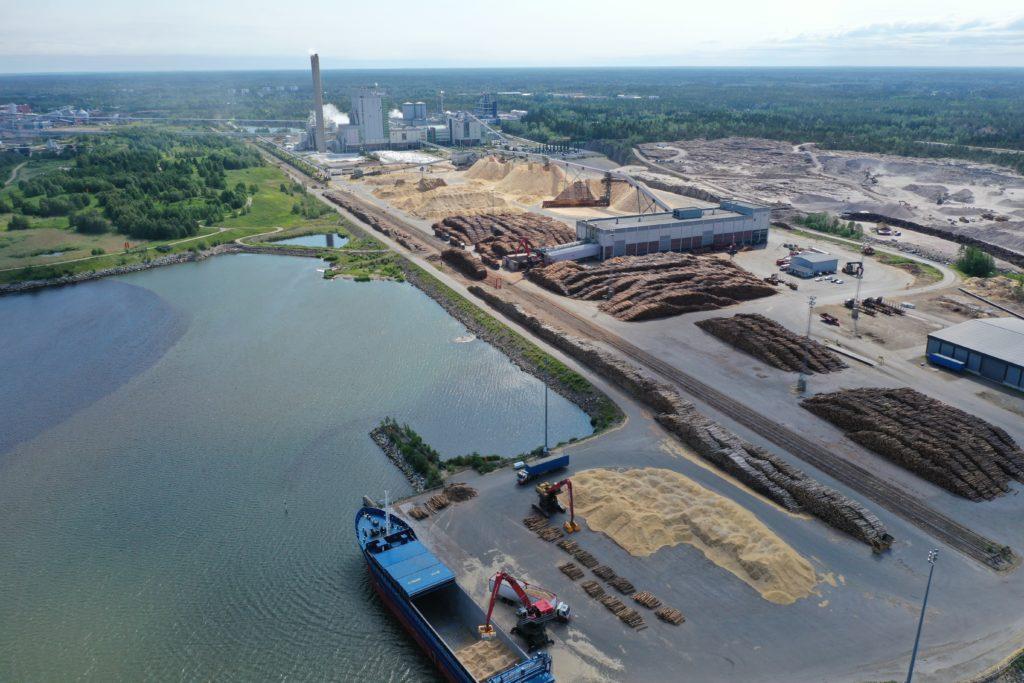
For roundwood handling in a port terminal, the best machines are mid-to-large hydraulic material handlers specifically configured for timber operations. The Mantsinen 70 is tailored especially for roundwood handling, while the Mantsinen 90, 120, and 160 are all strong performers in high-frequency timber operations where reach, speed, and grab capacity are critical.
Roundwood handling places specific demands on a machine. The boom geometry needs to allow deep reach into stacks and vessels, the hydraulic system must deliver enough closing force to grip uneven log bundles securely, and the undercarriage must be stable enough to handle the dynamic loads that come with swinging heavy timber at speed. We are the only manufacturer in the industry that also operates our own machines at woodyards, which means every design decision in our timber-configured machines comes from direct operational experience rather than theoretical assumptions.
The Mantsinen 60 is also worth considering for mid-scale timber operations at terminals and mills. It carries all the proven qualities of larger models in a more compact package, making it a practical choice where space is limited or where handling volumes do not justify a larger machine.
What’s the best machine for bulk material handling in ports?
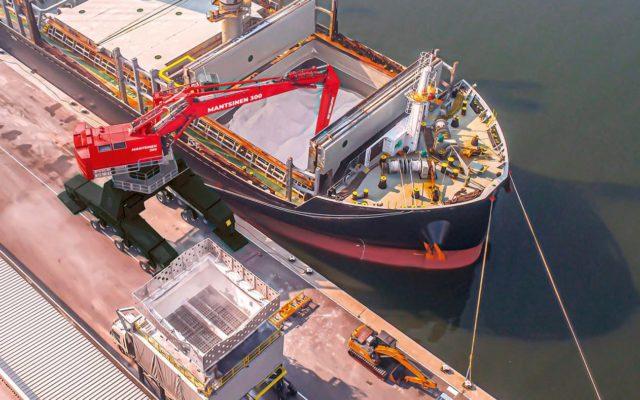
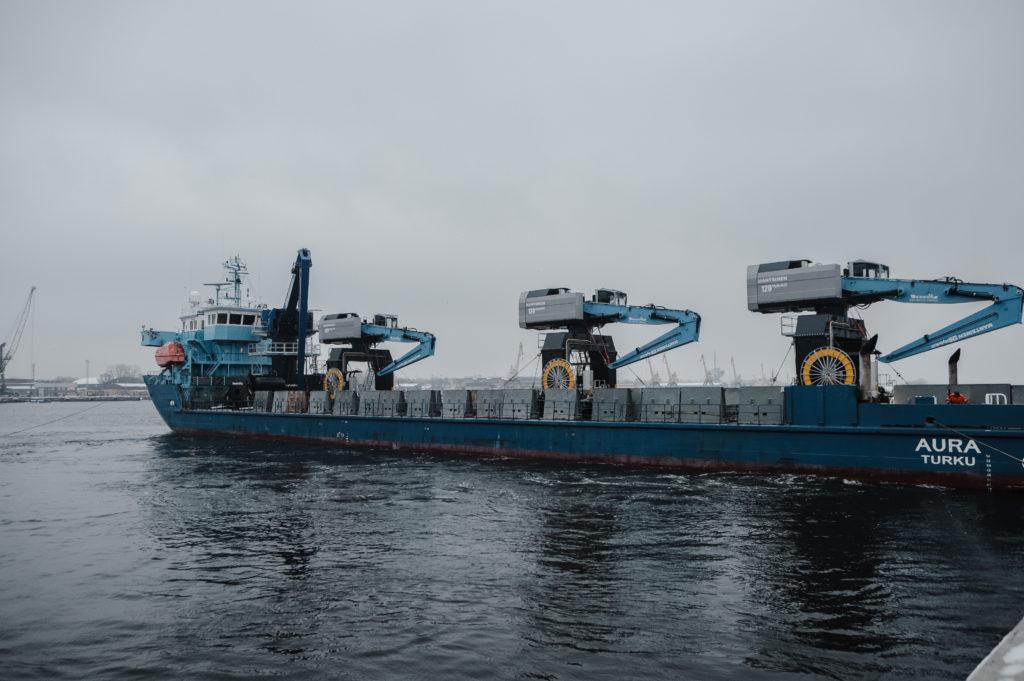
For bulk material handling in ports, the best machine is a hydraulic material handler equipped with a correctly sized clamshell bucket matched to the specific material being handled. The Mantsinen 120, 140, 160, 200, and 300 are all proven bulk handlers, with the right choice depending on vessel size, required throughput, and the density of the material.
Clamshell bucket selection is just as important as machine size. We offer a wide range of clamshell buckets designed for materials ranging from light wood chips and grain to heavy iron ore and pellets. The shape, volume, and cylinder force of the bucket must be matched to the material’s flow characteristics to achieve maximum fill rates and minimum spillage. Multiple quick-coupler options make switching between attachments fast and safe, so a single machine can handle different bulk commodities within the same shift.
For the largest vessels and the highest throughput demands, the Mantsinen 300 is the world’s largest hydraulic material handling machine and takes vessel loading and unloading efficiency to a level that no other machine on the market can match. For medium-sized ports and terminals, the Mantsinen 200 and 160 are workhorses that combine reach, capacity, and speed in a package that suits the majority of bulk operations.
How do you handle scrap metal efficiently at a port?
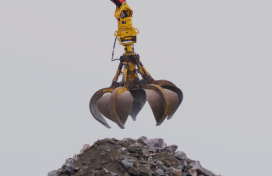
Efficient scrap metal handling at a port requires a tough, high-classification machine paired with the correct scrap grab for the material type. The key is matching the number of tines and tine geometry to the specific scrap being moved, whether the priority is material penetration, grab fill, or maneuverability in confined spaces such as truck trailers or railcars.
We offer scrap grabs with four, five, or six tines, and three different tine models: open, semi-open, and closed. Four-tine grabs are efficient for loading or unloading scrap from semi-truck trailers and railcars, where the grab needs to reach into a narrow opening. Five- and six-tine grabs are the standard choice for yard and vessel operations where maximizing fill weight per cycle is the priority.
Every Mantsinen machine is designed to the highest machine design classification, which matters enormously in scrap handling. Scrap is one of the most abusive materials a machine will encounter, and a machine built to a lower classification will show fatigue and structural wear far sooner. The combination of a robust machine and the right grab directly reduces cost per ton handled and extends the working life of both the machine and the attachment. To find the right configuration for your scrap handling needs, contact our dedicated port equipment sales team.
Should a port invest in a hybrid or diesel material handler?
A port should strongly consider a hybrid material handler if reducing energy costs, lowering emissions, and meeting tightening environmental regulations are operational priorities. Hybrid technology delivers these benefits without sacrificing performance, making it the more future-proof investment for most modern port operations.
Our Mantsinen Hybrilift® energy recovery system reduces energy consumption and costs by up to 50 percent by capturing the energy generated when the boom lowers and reusing it in subsequent lifts. This is not a marginal saving: across thousands of cycles per day, the cumulative reduction in fuel consumption and emissions is substantial. Development of this system began in 2006, which means the technology is mature, proven, and continuously refined.
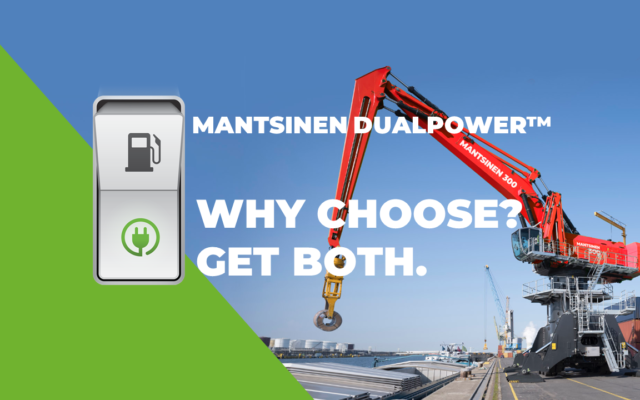
For ports that need maximum flexibility in positioning, the Mantsinen DualPower concept combines an electric motor and a diesel engine in a single machine. This means the machine can operate on grid power when connected and switch to diesel when working in areas without electrical infrastructure. The result is a machine that delivers the efficiency and lower emissions of electric operation wherever possible, without the operational limitations of a purely electric machine.
A purely diesel machine remains a valid choice in environments where a grid connection is impractical and where the operation does not face near-term emissions regulation. However, for most port and terminal operators investing in new equipment today, the hybrid or dual-power option provides a stronger return over the full life cycle of the machine, both financially and in terms of regulatory resilience. Our maintenance and support services for port equipment are designed to keep your machine performing at its best throughout its operational life.