What are smart material handling solutions for ports?
Ports and terminals operate under constant pressure to move more cargo, faster, with fewer resources and lower emissions. The equipment at the heart of these operations—the material handler—has evolved dramatically in recent years. Smart material handling solutions are no longer a luxury reserved for the world’s largest facilities. They are a competitive necessity for any port that wants to survive and grow in a demanding global logistics environment.
Whether you manage a bulk terminal handling wood chips and grain, a steel facility processing heavy coils, or a mixed-cargo port dealing with containers and breakbulk, the questions around equipment choice, technology, and sustainability are the same. This article answers the most important ones directly, so you can make informed decisions about port material handling for your operation.
Why does material handling efficiency matter in port operations?
Material handling efficiency in port operations directly determines profitability, throughput capacity, and competitive position. Every minute a vessel spends waiting at berth costs money. Faster loading and unloading cycles mean more ships served, lower demurrage costs, and stronger relationships with shipping lines. Inefficient equipment is not just slow; it is expensive at every level of the operation.
Port operations today exist in a fiercely competitive environment where only the most efficient techniques and solutions survive. Handling capacity, machine uptime, fuel consumption, and operator productivity all feed directly into the cost per ton moved. When that cost is high, ports lose contracts to rivals that have invested in better equipment and smarter processes.
Beyond direct costs, inefficiency creates knock-on problems throughout the logistics chain. Congestion at the berth delays inland transport. Slow cargo turnover reduces yard capacity. These bottlenecks compound quickly. Investing in high-performance port material handling equipment is therefore not just about speed; it is about maintaining control of the entire logistics process, from vessel to storage to onward transport.
How does Hybrilift® technology improve port material handlers?
Hybrilift® technology improves port material handlers by capturing and reusing energy that traditional machines waste. When a machine lowers its boom or releases a load, conventional hydraulic systems dissipate that kinetic energy as heat. The Hybrilift® system recovers this energy from the boom’s downward movement and feeds it back into the machine’s power cycle to assist subsequent lifting operations, significantly reducing fuel consumption and operating costs.
Our Mantsinen Hybrilift® energy recovery and storage system demonstrates exactly how this works in practice. Development began in 2006, and the system uses the energy generated by boom movements to power subsequent lifting operations. The result is an energy consumption reduction of up to 50 percent compared with conventional machines. For a port running multiple machines around the clock, that saving translates into a substantial reduction in annual fuel costs and carbon output.
What are the operational benefits beyond fuel savings?
Machines equipped with Hybrilift® also deliver benefits that go beyond the fuel bill. Reduced heat generation means less thermal stress on hydraulic components, which extends service intervals and reduces maintenance costs. Lower engine load during recovery phases reduces noise levels, which matters increasingly in ports located near urban areas. Operators also report smoother, more responsive machine behaviour because the energy recovery system helps stabilise hydraulic pressure across the work cycle.
For port operators weighing the business case for this technology, the combination of lower running costs, reduced maintenance demands, and improved environmental compliance makes it a compelling investment. The technology is mature, field-proven, and available across a range of machine sizes suited to different port scales and cargo types.
What’s the difference between electric and diesel material handlers for ports?
The key difference between electric and diesel material handlers for ports is how they source and consume power. Diesel machines are self-contained and fully mobile, running on their own fuel supply. Electric machines draw power from the grid, producing zero direct emissions at the point of use but requiring fixed power infrastructure. Each suits different operational contexts.
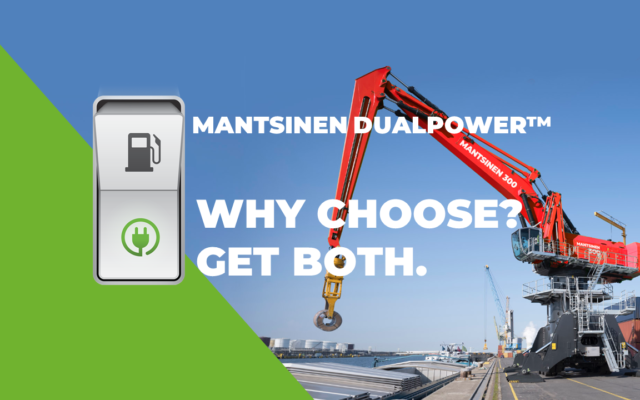
Our Mantsinen DualPower concept addresses this distinction directly by combining both power sources in a single machine. DualPower is the first dual-power concept in material handling machines, integrating an electric motor and a diesel engine so operators can switch between them depending on where and how the machine is working. When operating near a power connection, the machine runs on electricity. When mobility is required away from fixed infrastructure, diesel takes over seamlessly.
Which power source suits which port environment?
Purely electric machines work well in fixed installations where the power supply is consistent and the machine does not need to travel significant distances. They are ideal for enclosed terminal environments with strict air quality requirements. Diesel machines offer maximum flexibility and are well suited to open bulk terminals, timber yards, and operations where the machine needs to move freely across large areas.
DualPower bridges the gap between these two models. It delivers the productivity and mobility of a diesel machine while offering the environmental and cost benefits of electric operation whenever conditions allow. For ports navigating tightening emissions regulations without wanting to sacrifice operational flexibility, this dual approach is a practical and future-ready solution.
What should ports look for when choosing a material handler?
When choosing a material handler for port use, the most important factors are lifting capacity, reach, work cycle speed, attachment compatibility, and total cost of ownership. The right machine must match the specific cargo types, vessel sizes, and throughput targets of the operation. A machine that excels in one application may be poorly suited to another.
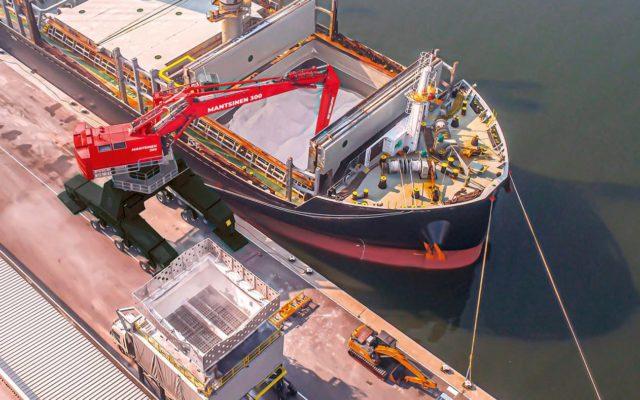
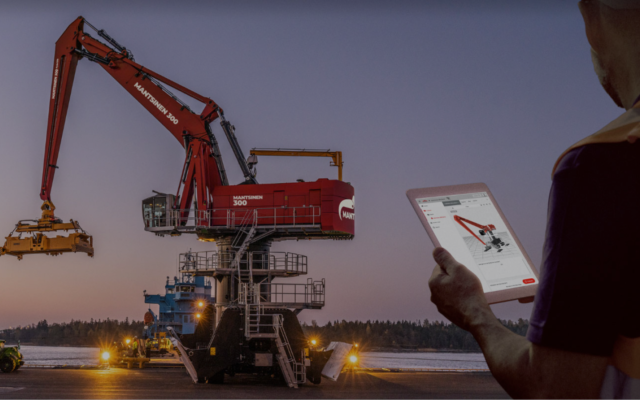
Capacity and reach should be matched to the largest vessels the port regularly handles. Our Mantsinen 300, the world’s largest hydraulic material handling machine, can serve vessels up to Panamax class and move a full 40-foot container approximately 22 metres without repositioning. For medium-scale ports, the Mantsinen 200 offers versatility across bulk materials, general cargo, and containers up to five rows wide and four high. Smaller operations benefit from machines like the Mantsinen 120 or 90, which combine speed, precision, and flexibility in a more compact format. To discuss the right configuration for your operation, contact our port equipment sales team directly.
How important is attachment versatility?
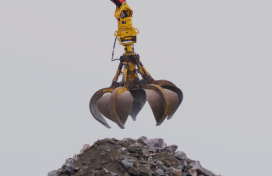
Attachment versatility is critical for ports handling multiple cargo types. A machine that can switch quickly between a clamshell bucket for bulk materials, a spreader for containers, and a grapple for scrap or timber is far more valuable than one optimised for a single application. Quick-coupler systems make this switching fast and safe, minimising downtime between cargo types.
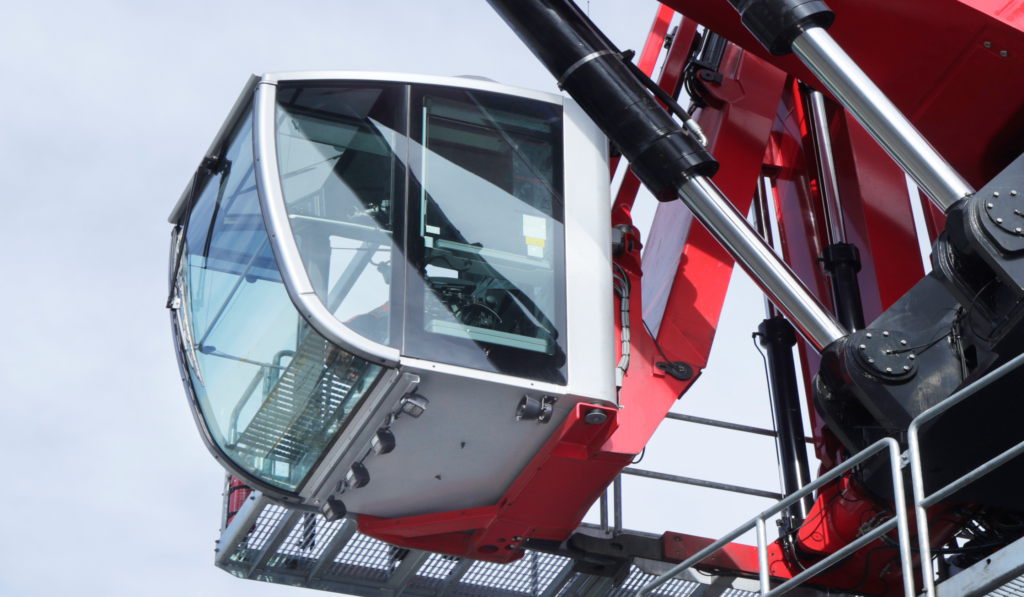
Operator comfort and control systems also deserve serious consideration. A well-designed cabin with clear sightlines, ergonomic controls, and load management technology reduces operator fatigue, improves precision, and lowers the risk of accidents. In high-throughput port environments, these factors directly influence both productivity and safety outcomes.
How can ports reduce emissions with smarter handling equipment?
Ports can reduce emissions with smarter handling equipment by adopting machines with energy recovery systems, dual-power or electric drive options, and intelligent load control technology that eliminates unnecessary engine load. Each of these features reduces fuel burn and direct exhaust emissions without requiring ports to sacrifice throughput or operational flexibility.
The environmental pressure on port operations is growing from multiple directions. Regulatory frameworks are tightening across Europe and globally, with emissions limits applying to both machine exhaust and overall terminal carbon footprint. Shipping lines and cargo owners are increasingly selecting ports based on sustainability credentials as part of their own environmental commitments. Ports that invest in cleaner equipment today are positioning themselves for a regulatory and commercial environment that will only become more demanding.
Smart material handling solutions contribute to emissions reduction in several compounding ways. Hybrilift® energy recovery reduces fuel consumption per ton moved. Electric drive eliminates direct emissions entirely during grid-powered operation. Faster work cycles mean vessels spend less time at berth with their own auxiliary engines running. Taken together, these gains can make a meaningful difference to a port’s overall environmental performance, not just its equipment specifications.
The path to a lower-emissions port operation does not require a wholesale replacement of all equipment overnight. Many ports begin by upgrading the highest-utilisation machines first, where the fuel and emissions savings are greatest, and build from there. The key is choosing equipment that is designed with sustainability as a core engineering principle rather than an afterthought, ensuring that every operating hour contributes to both productivity and environmental progress. Our port equipment maintenance and support services are designed to keep machines performing at their best throughout their working life.