Which manufacturers offer material handling solutions for ports?
Port operators face constant pressure to move more cargo faster, at lower cost, and with a smaller environmental footprint. The equipment choices made at the terminal level directly determine whether an operation stays competitive or falls behind. Understanding the landscape of material handling solutions for ports is the first step toward making smarter procurement decisions.
This guide answers the most common questions port logistics professionals ask when evaluating port material handlers, harbour crane manufacturers, and the technologies that separate leading terminals from the rest. Whether you are upgrading an existing fleet or specifying equipment for a new terminal, the answers below will help you make a confident, informed choice.
What are material handling solutions for ports?
Material handling solutions for ports are the machines, attachments, and supporting technologies used to load, unload, and move cargo between vessels, storage areas, and transport links. They include hydraulic material handlers, harbour cranes, conveyor systems, grab attachments, and energy management systems designed specifically for the demands of port and terminal environments.
In practice, a complete port material handling solution goes well beyond the machine itself. The right combination of equipment addresses the full logistics chain: vessel turnaround time, storage throughput, dust and spillage control, and integration with rail or road transport. Bulk materials such as wood chips, grain, iron ore, fertilisers, and scrap metal each place different demands on equipment, which is why leading manufacturers offer a wide range of machine sizes and interchangeable attachments.
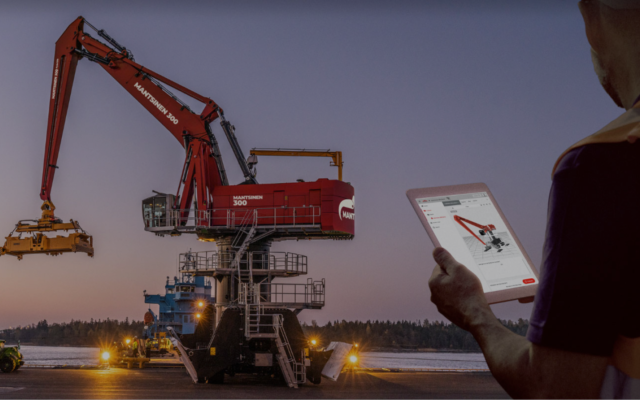
Modern port logistics equipment also incorporates intelligent control systems, load monitoring, and energy recovery technology. These additions reduce operator fatigue, improve safety, and lower the cost per handled tonne over the machine’s working life. The most capable solutions today are designed not just to handle cargo but to give terminal operators a measurable competitive advantage.
Which manufacturers make material handling equipment for ports?
The main manufacturers of port material handling equipment include both global crane producers and specialist hydraulic handler manufacturers. Key names in the sector include Liebherr, Sennebogen, Konecranes, Terex Port Solutions, and Mantsinen. Each company focuses on different segments, machine sizes, and technological priorities.
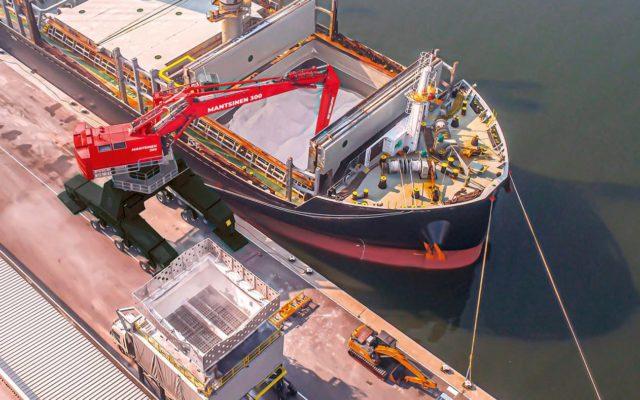
Liebherr and Konecranes are well known for mobile harbour cranes and ship-to-shore equipment at large container terminals. Sennebogen has a strong presence in bulk and recycling applications. Terex Port Solutions covers a broad range of port crane types. We at Mantsinen occupy a distinct position as a specialist in hydraulic material handlers, with a product range that spans from compact machines suited to smaller terminals all the way up to the Mantsinen 300, the world’s largest hydraulic material handling machine.
What sets manufacturers apart is not just machine size or lifting capacity. After-sales support, parts availability, operator training, and the manufacturer’s own operational experience all influence the total value delivered over a machine’s working life. We are the only manufacturer in this industry that also operates our own machines at forestry and steel industry sites, giving us first-hand insight that feeds directly back into product development.
What’s the difference between a harbour crane and a hydraulic material handler?
A harbour crane typically uses a cable-and-hook system to lift loads, while a hydraulic material handler uses a hydraulic boom with interchangeable grab or bucket attachments. The key practical difference is versatility and cycle speed: hydraulic material handlers can more than double handling capacity compared to traditional cable cranes in many bulk-handling applications.
How cable cranes work
Traditional cable harbour cranes lift loads via wire ropes and a hook. They are well suited to container handling and general cargo where standardised lifting points are available. However, they are less effective with loose bulk materials such as grain, wood chips, or scrap, where a grab attachment needs to open, close, and penetrate the material pile with precision and speed.
How hydraulic material handlers work
Hydraulic material handlers use a jointed boom driven by hydraulic cylinders, giving the operator precise three-dimensional control over the attachment. The hydraulic system allows faster open-and-close cycles on grabs and buckets, better penetration into bulk piles, and the ability to switch between different attachments quickly using a quick-coupler system. This makes them far more productive for bulk, scrap, timber, and mixed-cargo terminals. Containers can also be handled efficiently with the right spreader attachment, making the hydraulic handler a genuine all-round solution for ports that handle diverse cargo types.
How does energy recovery technology improve port material handlers?
Energy recovery technology in port material handlers captures kinetic energy from the boom’s lowering movement and reuses it to power subsequent lifting movements. This approach can reduce fuel consumption and energy costs by up to 50 %, which represents a significant saving across the continuous duty cycles typical in busy port operations.
Our Mantsinen Hybrilift® system was developed from 2006 onward and is now a patented feature across our machine range. When the boom lowers a loaded grab, the hydraulic system captures the kinetic energy and stores it for reuse in the next lift cycle. Over thousands of cycles per day, these savings accumulate into substantial reductions in both operating costs and carbon emissions.
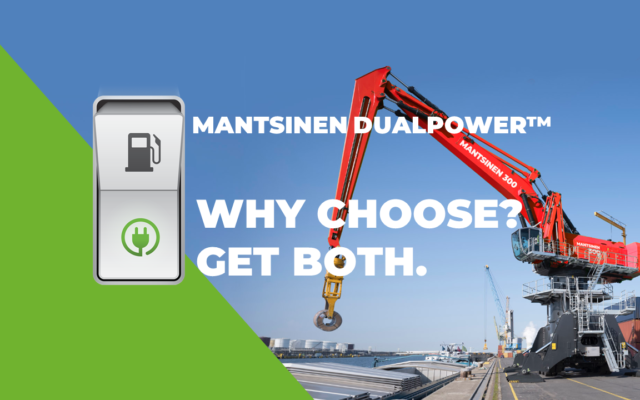
Beyond energy recovery, the Hybrilift® system also reduces heat generation in the hydraulic system, which lowers maintenance requirements and extends component life. For terminal operators facing tightening environmental regulations, Hybrilift® helps meet emissions targets without sacrificing productivity. Our DualPower concept takes this further by combining an electric motor with a diesel engine, giving operators the flexibility to run on shore power where it is available and switch to diesel when mobility is needed, delivering the best of both worlds in a single machine.
What should port operators look for when choosing a material handler manufacturer?
Port operators should evaluate manufacturers on five core criteria: machine performance and capacity range, energy efficiency technology, attachment versatility, after-sales support and parts availability, and the manufacturer’s proven experience in comparable port environments. A manufacturer that scores well across all five areas will deliver a lower total cost of ownership than one that excels in only one dimension.
- Performance and capacity range: Does the manufacturer offer machines sized appropriately for your vessel class, cargo volumes, and terminal layout?
- Energy efficiency: Does the machine incorporate energy recovery systems that reduce operating costs over its working life?
- Attachment versatility: Can the machine handle all the cargo types your terminal processes, with quick and safe attachment changes?
- Support and parts availability: How quickly can the manufacturer supply spare parts and technical support services to minimise downtime?
- Operational track record: Does the manufacturer have verified references in ports and terminals handling similar materials and volumes?
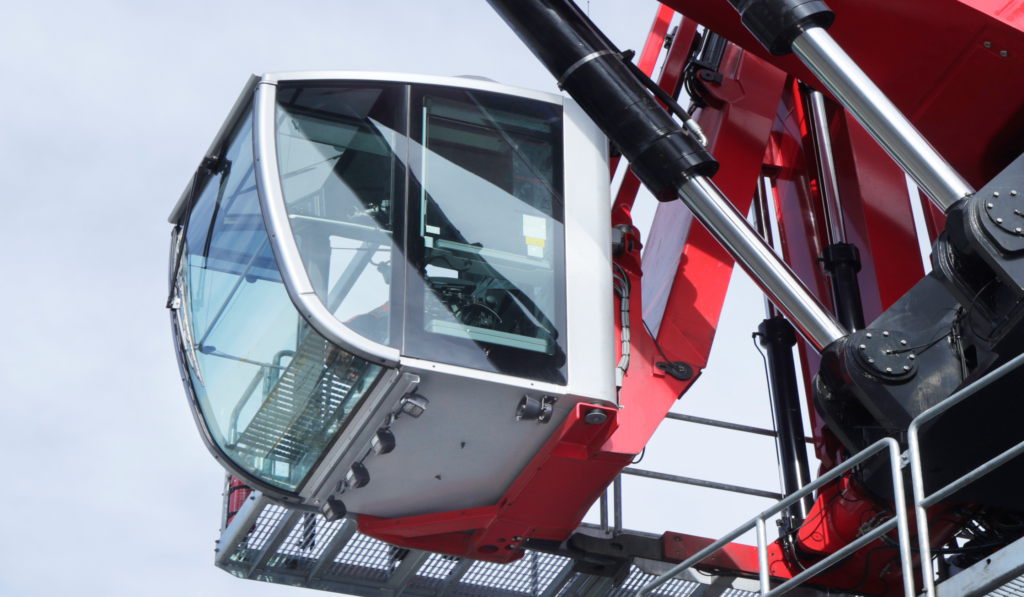
It is also worth asking whether the manufacturer has direct operational experience running its own machines in demanding environments. This kind of hands-on knowledge leads to design decisions that make a real difference to operators, from cab ergonomics and visibility to control system responsiveness and maintenance access.
Which material handler is best for high-volume bulk terminals?
For high-volume bulk terminals handling large vessels and continuous cargo flows, the best material handler is one that combines maximum grab capacity, fast work cycles, long reach, and reliable energy efficiency. In this class, the Mantsinen 300 stands out as the world’s largest hydraulic material handling machine, capable of servicing vessels up to Panamax class while maintaining the agility and precision of smaller machines.
The Mantsinen 300 is engineered specifically for the demands of large bulk terminals. Its next-generation Hybrilift® energy recovery system is patented for this model, and its work cycle speed delivers the best productivity in its size class. Despite its scale, the machine can move a full 40-foot container approximately 22 metres without repositioning, making it genuinely versatile across mixed-cargo operations.
For medium-scale bulk terminals, the Mantsinen 200 offers significant reach and capacity, combined with the ability to handle full containers up to five rows wide and four high, making it the preferred choice for ports that handle a mix of bulk and general cargo. The Mantsinen 160 is the right choice when speed is the top priority, with unmatched cycle times in high-frequency bulk and timber operations. Selecting the right model depends on your vessel size, cargo mix, and throughput targets, and we are always ready to help port operators find the right sales solution to their specific operational requirements.