Do we need different machines for different vessel sizes?
Most bulk terminals do not need different machines for every vessel size they handle. A well-specified hydraulic material handler can work effectively across a broad range of vessel categories, from small coastal feeders up to mid-size bulk carriers, provided the machine is matched to the terminal’s dominant cargo type and operational rhythm. Where vessel size variation becomes a genuine equipment question is at the extremes: very small vessels and very large Panamax or Capesize carriers often pull in opposite directions when it comes to reach, capacity, and cycle time. The sections below unpack the specific factors that drive that decision.
What factors actually determine which machine handles a vessel?
The key factors that determine which material handler suits a given vessel are outreach, lifting capacity, and grab volume, not vessel size alone. A machine needs to reach across the hold, lift a full grab at maximum radius, and cycle fast enough to meet the vessel’s discharge window. Cargo type, berth geometry, and whether the terminal operates on a fixed or flexible schedule all shape the answer as much as the ship’s dimensions do.
Outreach is often the binding constraint. A vessel with a wide beam demands more horizontal reach from the handler than a narrow coaster of similar tonnage. Lifting capacity matters because a full grab of iron ore weighs significantly more than the same volume of wood chips, meaning two vessels of identical size may require machines with very different rated capacities depending on what they carry.
Cycle time is the third pillar. Port operators managing bulk terminal operations managing tight turnaround windows need a machine that can sustain throughput across a full shift without overheating or excessive downtime. This is where power system design, including energy recovery systems, enters the selection conversation alongside pure mechanical specifications.
What are the main vessel size categories handled in bulk terminals?
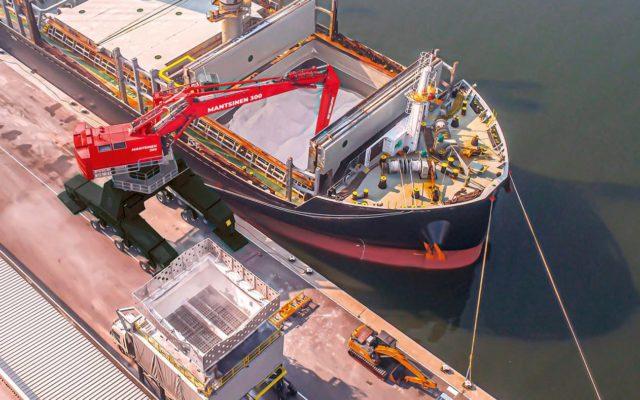
Bulk terminals typically encounter four broad vessel size categories: small coastal and river barges, handysize bulkers, supramax and ultramax vessels, and large Panamax or Capesize carriers. Each category brings different hold dimensions, cargo volumes per call, and discharge time expectations that shape equipment requirements at the berth.
- Coastal and river barges: Typically under 5,000 DWT, shallow draft, narrow beam. Fast turnaround is the priority, and a single mid-size handler usually manages the full discharge.
- Handysize bulkers (10,000 to 40,000 DWT): The most common vessel type at regional bulk terminals. Well within the working envelope of a modern large hydraulic material handler.
- Supramax and ultramax (40,000 to 65,000 DWT): Wider holds and larger cargo volumes per call. These vessels benefit from high-capacity handlers with strong outreach and large grab capacity.
- Panamax and Capesize (65,000 DWT and above): The largest category most bulk terminals encounter. Their hold dimensions and cargo volumes often require either a purpose-specified very large handler or multiple machines working simultaneously.
Understanding which categories dominate a terminal’s call pattern is the starting point for any meaningful equipment specification exercise.
Can one hydraulic material handler work across multiple vessel sizes?
Yes, a single hydraulic material handler can work effectively across multiple vessel size categories, particularly across the handysize to supramax range, which covers the majority of bulk terminal traffic worldwide. Modern large-format handlers are engineered with enough outreach, lifting capacity, and grab versatility to handle different hold geometries and cargo types without requiring a machine change between vessels.
The practical range of a single machine depends on how it is specified at the point of purchase. A handler configured with the right boom geometry, a high-capacity grab, and a robust hydraulic system can shift from discharging a 25,000 DWT grain carrier in the morning to loading a 55,000 DWT coal vessel in the afternoon. The operator adjusts grab selection and working radius; the machine adapts.
Where a single machine starts to show its limits is at the far ends of the size spectrum. Very small barges may require careful positioning to avoid overreaching, while very large Capesize holds may exceed the practical working radius of a standard handler. These edge cases are real but represent a minority of calls at most terminals.
When does a terminal actually need more than one machine type?
A terminal genuinely needs more than one machine type when its vessel call mix spans categories that pull equipment specifications in incompatible directions, or when throughput targets cannot be met by a single handler working alone. The clearest signals are when the terminal regularly receives both very small barges and large Panamax carriers, or when discharge windows are so tight that one machine cannot sustain the required tonnage per hour.
Cargo variety that demands different grab configurations
Some terminals handle cargo types with very different density and flow characteristics, such as wood chips alongside iron ore or grain alongside scrap metal. While grab attachments can be changed, a terminal with high daily volume across incompatible cargo types may find it more productive to dedicate machines to specific material streams rather than switching equipment between vessels.
Throughput targets that exceed single-machine capacity
When a terminal’s contracted discharge rate for large vessels exceeds what one handler can deliver within the laytime window, adding a second machine of the same or complementary type is the practical answer. This is a throughput decision, not strictly a vessel-size decision, but the two are connected because larger vessels carry more cargo and impose tighter time pressure per tonne handled.
How does energy recovery technology affect machine selection for different vessels?
Energy recovery technology broadens the practical range of a single machine by reducing the energy cost of high-cycle operations, making it viable to use one handler intensively across varied vessel types without the fuel and maintenance penalties that would otherwise push operators toward downsizing or machine specialisation. Terminals handling multiple vessel categories in a single shift benefit directly from a system’s ability to recover and reuse energy across the full working day.
Our Mantsinen Hybrilift® system captures the kinetic energy generated when the boom is lowered and feeds it back into the machine’s power cycle to assist subsequent boom lifts, reducing energy consumption by up to 50 percent compared to conventional hydraulic handlers. In practical terms, this means a terminal can run a large-capacity handler across handysize and supramax vessels throughout a shift without the energy cost that would typically accompany that level of sustained output.
For terminals weighing whether to invest in one large handler equipped with the Hybrilift® system or two smaller conventional machines, the operating cost profile often changes the economics substantially. Lower fuel consumption and reduced heat generation also extend service intervals, which matters when a machine is expected to cover a wide range of vessel calls with minimal planned downtime.
What should port operators ask before choosing handling equipment?
Port operators should ask six core questions before committing to bulk cargo handling equipment: What is our dominant vessel size category? What cargo types do we handle and in what volume? What are our discharge rate obligations? What is our berth geometry and available footprint? What are our emissions and energy targets? And what is our total cost of ownership over the machine’s service life, not just the purchase price?
The dominant vessel category question sets the baseline specification. If the terminal’s bread-and-butter traffic is handysize bulkers with occasional supramax calls, the machine should be optimised for that range rather than over-specified for rare Panamax visits. Cargo type determines grab selection and structural loading requirements. Discharge rate obligations define the minimum throughput the machine must sustain, which in turn drives decisions about the power system, hydraulic capacity, and whether one machine or two is the right answer.
Berth geometry is often underweighted in early specification discussions. A tight berth with limited outreach clearance may constrain machine size regardless of what the vessel call mix demands. Emissions and energy targets are increasingly shaping equipment decisions in 2026 as port authorities and cargo owners apply pressure across the supply chain. A machine equipped with an energy recovery system such as Hybrilift® may satisfy regulatory requirements that a conventional diesel handler cannot meet.
Finally, total cost of ownership over a ten to fifteen year horizon almost always tells a different story than the purchase price alone. Fuel, maintenance, operator training, and parts availability all belong in the calculation before a terminal signs a specification. Our equipment maintenance and support services all belong in the calculation before a terminal signs a specification.