How can we increase throughput or efficiency in a bulk cargo port without expanding terminal or port?
You can increase throughput in a bulk cargo port without physical expansion by optimizing machine performance, improving operational workflows, and upgrading to high-capacity material handlers. The most impactful gains come from reducing cycle times, minimizing idle periods, and ensuring your handling equipment operates at peak efficiency. Below, we unpack the specific questions port operators ask most often when tackling this challenge.
What are the biggest bottlenecks limiting throughput in bulk cargo ports?
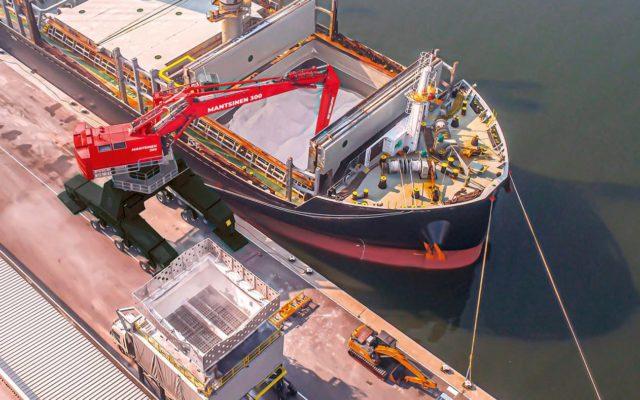
The biggest bottlenecks limiting throughput in bulk cargo ports are equipment downtime, slow cycle times, poor load coordination, and inefficient material flow between vessel, stockyard, and transport. These operational friction points compound quickly at scale, and in high-volume bulk terminals handling ports and terminal operations handling materials like woodchips, coal, scrap metal, or grain, even small delays per cycle translate into significant daily capacity losses.
Equipment-related bottlenecks are often the most consequential. When a material handler sits idle for maintenance, refueling, or operator changeover, the entire unloading or loading chain stalls. Ports relying on older machines with limited reach or lower lifting capacity frequently find that the machine itself is the rate-limiting factor, not the berth, the vessel, or the available labor.
Coordination gaps between vessel scheduling, stockyard management, and outbound transport create a second layer of constraints. Even a well-performing machine cannot compensate for a stockyard that is full, a conveyor that is backed up, or a truck queue that disrupts the flow pattern. Addressing throughput means looking at the full chain, not just the crane or handler in isolation.
How does machine performance directly affect port handling capacity?
Machine performance directly determines port handling capacity because the material handler sets the pace of every loading and unloading operation. Lifting capacity, reach, cycle speed, and uptime are the core variables. A handler that can lift more per grab, swing faster, and operate longer without interruption moves materially more tonnage per shift than a lower-spec machine on the same berth.
Reach and lifting height matter especially in bulk terminals where vessels vary in size and cargo profiles differ. A machine with greater outreach can work deeper into a vessel hold without repositioning, which cuts cycle time. Higher lifting capacity means fewer grabs are needed to clear the same volume, reducing the total number of movements per vessel call.
Uptime is equally critical. A machine achieving 90% availability across a shift delivers dramatically more throughput than one achieving 75%, even if their rated capacities are identical. This is why machine reliability, ease of maintenance, and access to rapid service support are not secondary concerns for port operators. They are central to the throughput equation.
Can electric material handlers increase efficiency without extra space?
Yes, electric material handlers can increase port efficiency without requiring additional terminal space. They do this by delivering higher usable power output, reducing energy-related downtime, and enabling more continuous operation within the same physical footprint. The efficiency gains come from the machine’s energy architecture, not from occupying more ground.
Our Mantsinen Hybrilift® system is a practical example of this principle. Hybrilift® captures the energy generated when the boom lowers and reuses it in subsequent boom lifting movements, reducing energy consumption by up to 50%. This means the machine can sustain higher operational intensity without proportionally higher fuel or electricity costs, and without the thermal or power limitations that cause conventional machines to throttle back during peak demand periods.
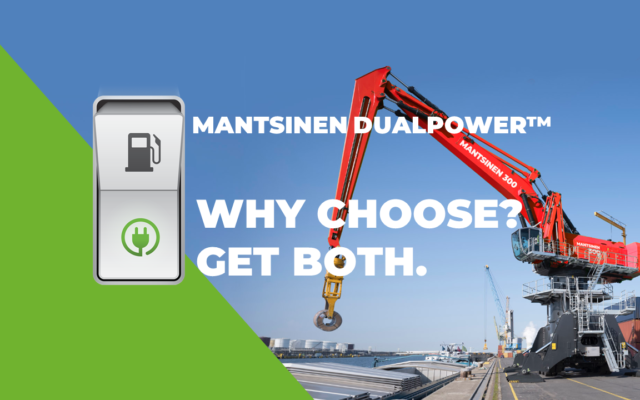
Our DualPower concept extends this further by combining a diesel engine with an electric motor. Operators gain the flexibility to run on electric power where a grid connection is available, reducing emissions and operating costs, while retaining diesel capability for full mobility when needed. For port terminals facing tightening environmental regulations in 2026, this flexibility also removes the compliance risk of being locked into a single power source.
What operational changes improve throughput without physical expansion?
Operational changes that improve throughput without physical expansion include extending shift patterns, optimizing vessel scheduling, reducing changeover and refueling time, improving grab selection for each cargo type, and using real-time data to identify and eliminate idle periods. These changes require no new land or infrastructure but can unlock significant additional capacity from existing assets.
Shift structure is one of the most straightforward levers. Many bulk terminals operate on patterns that leave equipment idle during low-demand windows. Extending operational hours or introducing overlapping shifts reduces the gap between rated machine capacity and actual daily throughput. Combined with better vessel scheduling that reduces waiting time at berth, these changes can meaningfully increase the number of vessel calls a terminal handles per week.
Grab and attachment optimization is frequently underestimated. Using the correct grab size and type for each cargo, whether that is a clamshell for bulk grain, a grapple for scrap, or a wood grab for chips, reduces the number of cycles needed and minimizes spillage. Spillage is a hidden throughput cost: every tonne that misses the conveyor or stockpile must be recovered, adding time and labor without contributing to productive movement.
How do ports measure and benchmark handling efficiency improvements?
Ports measure handling efficiency using metrics such as tonnes per hour (TPH), berth occupancy rate, crane or handler utilization rate, vessel turnaround time, and cost per tonne moved. Benchmarking involves comparing these figures against historical performance, industry norms, or peer terminals of similar size and cargo mix. Consistent measurement is what separates genuine improvement from the appearance of improvement.
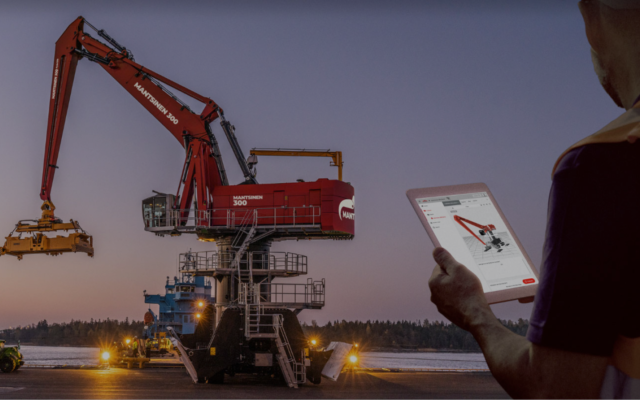
Tonnes per hour is the most direct measure of handling productivity. It captures how much cargo moves through the system per unit of time and reflects the combined effect of machine performance, operational coordination, and cargo characteristics. Tracking TPH by shift, by operator, and by vessel type reveals where variability is highest and where targeted interventions will have the most impact.
Berth occupancy and vessel turnaround time connect machine-level efficiency to commercial outcomes. A terminal that turns vessels faster can handle more calls per berth per month, which directly increases revenue capacity without adding infrastructure. Tracking these alongside machine utilization rates helps port managers distinguish between equipment-driven bottlenecks and process-driven ones, ensuring that investment and operational changes are directed at the right constraint. To explore how expert support can help optimize these outcomes, visit our port equipment and maintenance services.