What affects the total cost of ownership of port handling equipment?
The total cost of ownership (TCO) of port handling equipment includes far more than the purchase price. It encompasses fuel and energy consumption, maintenance and spare parts, downtime losses, operator costs, and end-of-life disposal — all of which typically dwarf the initial capital outlay over a machine’s operational lifetime. For bulk material handlers working in demanding port and terminal handling environments, understanding TCO is essential to making sound investment decisions.
The sections below unpack the key questions port operators ask when evaluating the true lifecycle cost of their equipment.
What are the biggest hidden costs in port equipment ownership?
The biggest hidden costs in port handling equipment ownership are unplanned downtime, spare parts logistics, and operator inefficiency. These costs rarely appear in a purchase comparison but routinely exceed the original machine price across a typical 15 to 20 year operational life. Energy consumption and compliance-related upgrades are also frequently underestimated at the point of purchase.
Port operators often focus on the sticker price when comparing machines, but the numbers that matter most accumulate quietly over years of operation. Spare parts availability is a prime example: a machine sourced from a manufacturer with a weak parts network can sit idle for days waiting on a critical component, and every idle hour translates directly into missed throughput. Similarly, operator training costs, safety incidents linked to poor ergonomics, and the gradual cost of fuel at scale all build into a figure that can be two to four times the original capital expenditure before the machine reaches retirement.
Environmental compliance is another cost that catches operators off guard. Tightening port emission regulations in European and global trade hubs means that diesel-only machines purchased today may require expensive retrofits or early replacement within a decade. Factoring in regulatory trajectory at the point of purchase is now a fundamental part of responsible TCO analysis.
How does fuel and energy consumption affect long-term equipment costs?
Fuel and energy consumption is typically the single largest operating cost for bulk material handlers in port environments, often accounting for 30 to 50 percent of total lifecycle costs. A machine that consumes significantly less energy per tonne handled delivers compounding savings year after year, making energy efficiency one of the highest-leverage variables in total cost of ownership calculations.
Hydraulic material handlers are energy-intensive by nature. They lift, slew, and lower heavy loads continuously across long shifts, and every movement that dissipates energy as heat rather than recovering it represents a direct cost. This is precisely why energy recovery systems matter so much in real-world port operations. Our Mantsinen Hybrilift® system captures the energy generated when the boom lowers and feeds it back into the boom’s lifting movements, reducing overall energy consumption by up to 50 percent compared to conventional machines.
At scale, those savings are substantial. A busy port terminal running multiple shifts across multiple machines will see energy cost reductions that run into hundreds of thousands of euros over a machine’s operational life. When evaluating harbour crane efficiency or comparing bulk material handlers, energy consumption figures should always be modelled across projected annual operating hours rather than compared as a simple specification number.
What maintenance factors drive the total cost of port handling machines?
The maintenance factors that most significantly drive port handling equipment costs are service interval frequency, spare parts availability, the complexity of hydraulic and mechanical systems, and access to manufacturer support. Machines designed for serviceability and backed by strong after-sales networks consistently deliver lower maintenance costs over their operational lives.
Preventive maintenance is far less expensive than reactive repair, yet many operators underinvest in scheduled servicing because the cost is visible and immediate while the avoided breakdown cost is hypothetical. In practice, a missed service on a high-cycle hydraulic machine can cascade into major component failure, with repair bills and downtime losses that far exceed what routine maintenance would have cost.
Hydraulic system complexity is a key differentiator between machines. Simpler hydraulic architectures with fewer potential failure points are inherently cheaper to maintain. Equally important is the manufacturer’s ability to supply genuine spare parts quickly. A machine with a 48-hour parts availability guarantee from the manufacturer has a structurally lower maintenance cost profile than one dependent on third-party supply chains with unpredictable lead times. Operators looking to minimise these risks can explore equipment lifecycle and support services that cover parts supply and technical assistance.
How does machine uptime affect the total cost of ownership?
Machine uptime directly affects TCO because every hour a port handling machine is unavailable represents lost throughput, potential contract penalties, and additional labour costs. High uptime is not just an operational metric — it is a financial one. A machine that operates reliably at 95 percent availability generates significantly more value over its lifetime than a cheaper machine running at 85 percent availability.
In port and terminal environments, material handling is rarely isolated. A single machine that handles bulk cargo at a berth is often part of a tightly sequenced operation involving vessels, conveyors, and storage. When that machine goes offline unexpectedly, the disruption ripples across the entire chain. Vessel demurrage fees alone can make a single unplanned breakdown extremely expensive.
Uptime is driven by a combination of machine build quality, maintenance discipline, and operator behaviour. Machines built with robust components rated for high-cycle industrial use, combined with structured preventive maintenance programmes and trained operators, consistently outperform machines selected on purchase price alone. When calculating material handling equipment lifecycle cost, always model uptime assumptions honestly — even a small difference in availability percentage produces a large difference in long-term value.
Should port operators choose diesel, dual-power, or electric material handlers?
The right power configuration for a port material handler depends on site infrastructure, operational intensity, and regulatory environment. Dual-power machines currently offer the best balance of flexibility and efficiency for most port operations, while fully electric machines suit sites with stable grid connections and predictable duty cycles. Pure diesel machines carry the highest long-term fuel and compliance risk.
Diesel machines remain capable and proven, but their TCO is increasingly burdened by fuel price volatility and tightening emissions regulations. Many European ports are now subject to environmental requirements that will restrict or penalise high-emission equipment within the coming years, making a diesel-only purchase a potentially short-sighted decision in 2026.
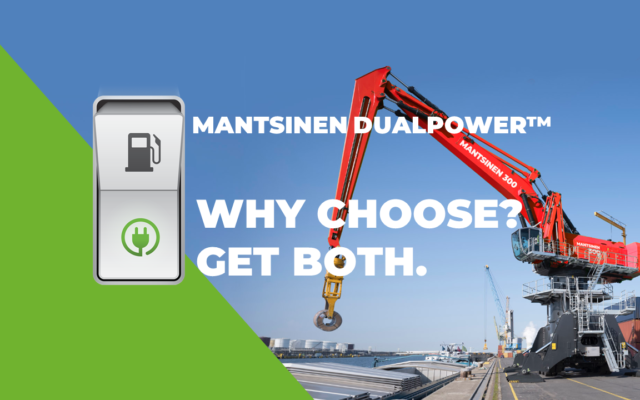
Dual-power configurations, such as our Mantsinen DualPower concept, combine a diesel engine and an electric motor to deliver the mobility of a conventional machine with substantially lower fuel consumption and emissions. This dual-power approach means operators are not dependent on fixed electrical infrastructure, which matters greatly in ports where machines need to move freely across the yard. Fully electric machines work well where grid connection is reliable and the machine’s operating pattern is consistent, but they require significant infrastructure investment upfront.
For most bulk terminal operators weighing port equipment operating costs over a full lifecycle, a dual-power material handler currently represents the lowest-risk, highest-value configuration — particularly when energy recovery systems such as Hybrilift® are integrated into the design.
How can port operators reduce the total cost of ownership over time?
Port operators can reduce the total cost of ownership of handling equipment by prioritising energy-efficient machines, implementing structured preventive maintenance programmes, investing in operator training, and selecting manufacturers who offer strong lifecycle support. These actions compound over time and consistently deliver greater savings than negotiating a lower purchase price.
- Choose energy-efficient equipment from the outset. Machines with integrated energy recovery systems reduce fuel and electricity costs every operating hour for the life of the machine.
- Implement preventive maintenance rigorously. Scheduled servicing prevents the expensive cascading failures that result from deferred maintenance on high-cycle hydraulic equipment.
- Train operators thoroughly. Skilled operators cause less mechanical wear, handle loads more efficiently, and identify early warning signs before they become costly failures.
- Evaluate total lifecycle cost, not purchase price. A machine that costs more upfront but delivers lower operating costs, higher uptime, and longer service life will almost always outperform a cheaper alternative on TCO.
- Factor in regulatory trajectory. Selecting equipment that already meets or exceeds current emission standards protects against costly compliance upgrades or early replacement.
- Partner with manufacturers who offer strong after-sales support. Fast parts availability and responsive technical support are not soft benefits — they directly reduce downtime costs and maintenance expenditure.
Reducing TCO is ultimately a discipline of long-term thinking. The decisions that deliver the greatest savings are made before a machine enters service, not after problems emerge. Port operators who model lifecycle costs carefully, select equipment with proven efficiency credentials, and maintain machines consistently are the ones who achieve the lowest cost per tonne handled over time.